




















The world of outdoor retail across the globe is evolving and quite rapidly at that. Today, customers want, nay expect, a seamless shopping experience. And this is true no matter if they are browsing online, visiting a physical store, or engaging with the brand on social media. Suffice it to say that an omnichannel approach – where all sales channels are integrated – is no longer a luxury. At this point in the market, such an approach has become a necessity for outdoor brands. Well, at least if they want to thrive in the competitive market. Unfortunately, traditional eCommerce platforms can often struggle to deliver a truly omnichannel experience. You can chalk up this struggle to siloed systems, complex integrations, high maintenance costs, and so much more. The important point is that all these factors can take a huge toll on operational efficiency and profit margins.
You don’t have to lose hope just yet though. I say this because there is a pretty nifty solution available at hand: Hyvä for Magento 2. Leveraging these two mighty powerful tools, outdoor retailers such as yourself stand to not only overcome these challenges but also unlock a whole new world of cost-effective omnichannel success.
Omnichannel Obstacles: Why Traditional eCommerce Isn’t Enough

The modern outdoor retail landscape is cut-throat. In the face of such a fiercely competitive market, COOs understand the importance of omnichannel retail. Unfortunately, conventional eCommerce platforms, particularly those using legacy themes, can disrupt the efforts to achieve a seamless customer experience. Here are some of the pain points you are likely facing as well:
Disjointed Data Silos
Legacy themes typically operate within a siloed system, making it difficult to get a unified view of customer data. Data from across different sales channels, such as online stores, physical stores, mobile apps, etc. I mean. Such a lack of centralized data, in turn, makes it challenging to personalize users’ shopping experience, track their journeys, and optimize marketing campaigns.
Optimize Your Outdoor Retail eCommerce
Discover how Hyvä for Magento 2 can streamline your operations and cut costs for better performance.
Limited Headless Potential
Even if you are operating your webstore on a robust platform, such as Magento 2, legacy themes can still limit its full potential. In regard to headless architecture, that is. You see, the headless approach separates the front-end (presentation layer) from the back end (data and functionality). This, in turn, allows for significantly greater flexibility and customization in building a truly omnichannel experience. However, legacy themes tightly coupled with the back end can hinder your ability to create a truly headless storefront. In fact, it can also take a toll on your ability to seamlessly integrate with other sales channels.
UX Woes
Legacy themes are usually not optimized for mobile browsing or even the latest web design trends. So, it is not hard to imagine why this would lead to a clunky and outdated user experience. The kind of experience that fails to engage customers on all devices and not just one. And as you already know, a poor UX can quickly drive customers to your competitors.
Maintenance Challenges
Legacy themes often need significant ongoing maintenance and development resources to ensure they function properly. This can be a major drain on the IT budget, taking resources away from strategic initiatives that could drive growth.
Hyvä + Magento 2 = The Omnichannel Answer for Outdoor Brands
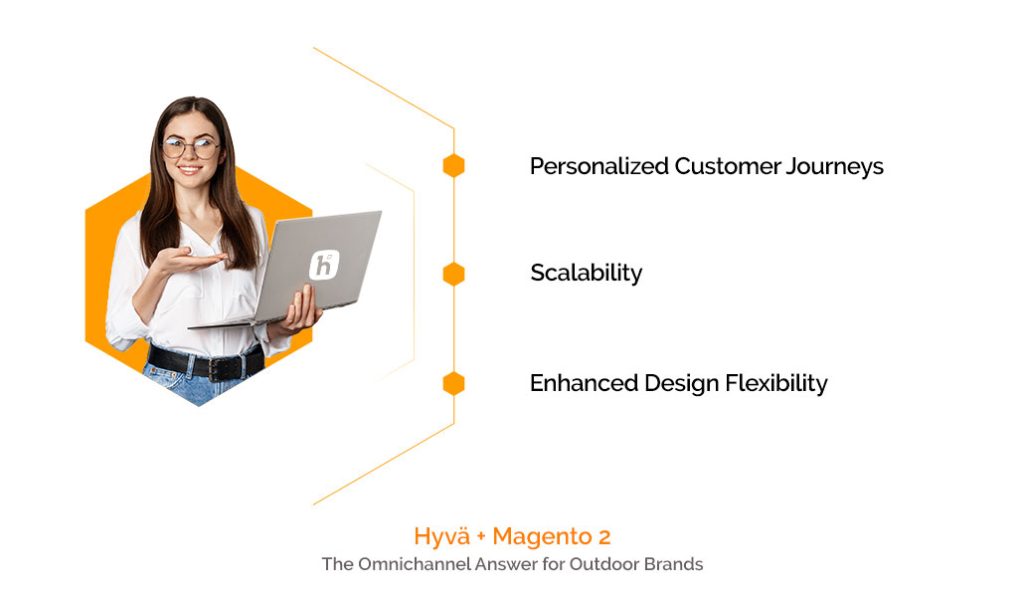
As you can imagine, the challenges outlined above can significantly hinder your ability to compete in today’s omnichannel landscape. Perhaps they already do. But fear not COOs! There is a powerful solution for you to consider: Hyvä combined with Magento 2. Hyvä is a game-changing Magento 2 theme, serving as the front-end layer, separate from the Magento 2 back-end that houses your product data, business logic, and core functionalities. Let us now discuss the benefits this separation allows for:
Personalized Customer Journeys
Example: A customer browses The Sporty Apparel website on their desktop and views several winter jackets. They then visit a physical store to try on a specific jacket but can’t find their desired size. With siloed data, the store associate has no way of knowing the customer’s online browsing history.
Hyvä Solution: Working alongside Magento 2’s built-in customer profile features, Hyvä can possibly contribute to a more unified customer experience. In this scenario, a store associate, with the customer’s permission and through functionalities within Magento 2 or potentially a Customer Relationship Management (CRM) system, can access their online browsing history and see which jackets they viewed. This personalized service can lead to a more positive shopping experience and a higher likelihood of conversion.
Scalability
Example: As Bosco Groceries experiences a surge in online sales during peak seasons, such as Black Friday, their eCommerce platform struggles. It can barely keep up with the increased traffic, leading to slow loading times and frustrated customers.
Hyvä Solution: Now, one may wonder how a theme can help with all that. Well, thanks to Hyvä’s lightweight design and focus on performance, you can ensure smooth operation even during traffic spikes. Bosco Groceries can rest assured their eCommerce platform won’t buckle under pressure and will provide a seamless shopping experience.
Achieve Omnichannel Success
Seamless shopping experiences are within reach with Hyvä and Magento 2. See how it can transform your outdoor retail business.
Enhanced Design Flexibility
Example: RedSchmauer, a Hemp clothing brand, wants to refresh their website design to reflect their brand’s commitment to sustainability. However, their current Magento theme with limited design options makes customization challenging.
Hyvä Solution: One of Hyvä’s biggest USPs is that it offers a clean and customizable codebase. So, RedSchmauer can leverage Hyvä’s flexibility to create a modern and visually appealing website design. Experienced service providers, such as Wagento, can ensure the design is in sync with their brand identity. We don’t have to tell you just how great this alignment is for attracting new customers and strengthening brand loyalty.
Final Thoughts
These are just a few examples of how Hyvä for Magento 2 can empower you to overcome the challenges of traditional outdoor retail eCommerce platforms and achieve omnichannel success. Hyvä’s unique capabilities help brands to create a seamless Magento 2 omnichannel shopping experience for their customers. The result? Better sales and brand loyalty, of course.
Are you ready to embark on your omnichannel journey? Wagento is your trusted partner for Hyvä and Magento 2 implementation. We offer extensive experience and a deep understanding of the unique challenges faced by outdoor retailers. Additionally, our commitment to transparency is underscored by our budget guarantee. In the unlikely event that project costs exceed the agreed-upon budget, Wagento will cover a month’s worth of your revenue.
Let Wagento help you transform your outdoor retail business into a thriving omnichannel powerhouse. Contact us today for a free consultation!
Frequently Asked Questions
Composable commerce is a modern approach to building eCommerce platforms using modular, best-of-breed components. Instead of relying on a single, monolithic system, you can “compose” your tech stack by selecting individual services—such as a CMS, PIM, or checkout engine—that are connected via APIs. This allows for greater flexibility, easier upgrades, and faster innovation across your eCommerce operations.
Composable technology refers to the practice of building digital systems using interchangeable and independent modules. In eCommerce, this often means selecting tools like headless CMS, ERP, CRM, and OMS, then connecting them through APIs to form a custom platform. The benefit of composable technology is that it enables you to scale and adapt quickly without being locked into a single vendor or system.
Composable architecture is the technical foundation of composable commerce. It follows an API-first, cloud-native, and microservices architecture model. This structure allows each system component (like search, pricing, or cart) to operate independently, making it easier to update, replace, or scale any part without affecting the others. Composable architecture is ideal for businesses that need agility and future-ready infrastructure.
Composable commerce is different because it shifts control back to the business. Traditional platforms are often monolithic, meaning all features are bundled together, which can slow down innovation and increase costs over time. In contrast, composable commerce allows businesses to choose only the tools they need, integrate them seamlessly, and adapt quickly as requirements evolve. This results in faster go-to-market, lower long-term costs, and a more tailored customer experience.
Headless commerce is an eCommerce architecture where the front-end (the “head”) is decoupled from the back-end systems. This means your storefront or user interface can be built using any framework or technology, while still communicating with back-end tools like your CMS, product database, or cart system via APIs. Headless commerce supports greater design flexibility, faster content delivery, and the ability to create consistent experiences across web, mobile, and other digital touchpoints.
Headless commerce works by allowing the front end and back end of your site to operate independently but stay connected through APIs. In a composable architecture, this headless structure is one of the key components—it enables businesses to swap or update the UI, checkout experience, or content engine without touching the core commerce engine. This leads to faster updates, better performance, and more freedom to create customized digital experiences for each channel or user group.