


















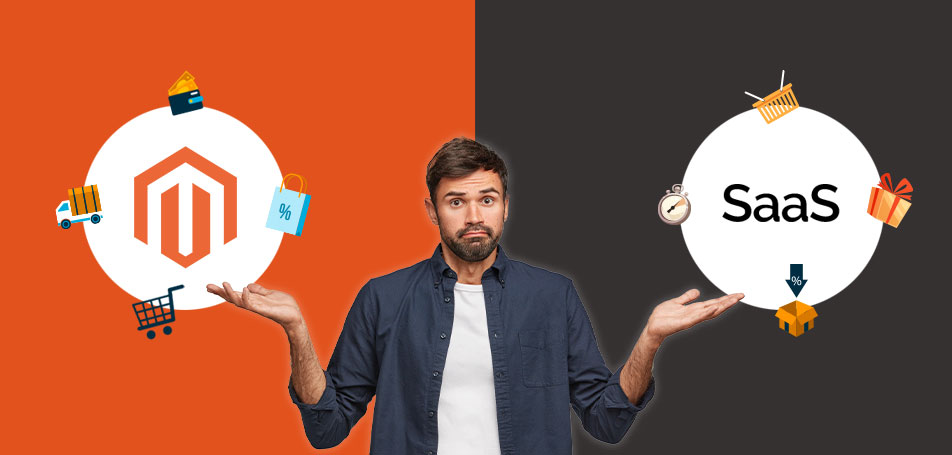
Hello, fellow online merchants! Today, we’re diving into the debate between Magento vs SaaS eCommerce solutions.
Are you considering switching from Magento to a SaaS eCommerce solution and don’t know what to do? Maybe you’ve decided to Google it, read articles, and try to figure it out on your own.
As someone who has navigated the complexities of different eCommerce platforms, I understand that having a suitable platform is crucial for your business’s growth and longevity.
Sometimes, we assume that switching platforms is necessary when facing operational hiccups. However, it’s essential to evaluate whether your current system, Magento, just needs some fine-tuning. Like maintaining a car, sometimes you need a better mechanic, not a new car. However, if you speak to a car salesperson, he/she will happily sell you a new car. A new car may have similar problems after some time or may only partially fit your business needs.
Let’s explore whether re-platforming is the right strategy for you.
“Switching platforms isn’t as simple as you may think.”
Because it isn’t! Even, if possible, it’s more akin to moving to a new house: a total reset that requires significant resources, disrupts operations, and incurs training costs. Remember, all platforms have strengths and weaknesses—the grass isn’t always greener on the other side!
Let Us Do the Switching Work
Get started with eCommerce platform migration by exploring the key differences today.
Understanding Magento vs SaaS eCommerce

Magento: The Open-Source Powerhouse
Magento is the powerhouse of flexibility, allowing bespoke tailoring of your eCommerce environment to fit your exact needs. This control comes with responsibilities like updates and security, akin to owning a house with a beautiful yard, two-car garages, and an oversized driveway with ample parking vs. an apartment. It might sound daunting, but this means you have room to grow and want your store to grow and evolve with your vision.
SaaS: The Convenient Alternative
SaaS platforms may simplify your eCommerce journey. They manage hosting, updates, and security. It’s like renting an apartment: walk in and start living. However, this convenience might limit how much you can personalize and grow with your space.
The Cost Factor
Magento’s Maintenance Costs
Investing in Magento is like investing in a single-family house rather than an apartment. Yes, there are costs for upkeep and enhancements, but you’re investing in the foundation of your digital presence, which allows for endless future customization and scalability.
SaaS Subscription Costs
While SaaS might seem financially manageable initially, subscription fees accumulate, potentially equaling or surpassing the cost of maintaining a Magento site over time. It’s convenient, like renting an apartment, but you never own it outright. Rent and HOA fees go up year by year.
Future-Proofing Your Business with Magento vs SaaS eCommerce
Flexibility with Magento
Magento offers unparalleled flexibility, crucial for businesses aiming to scale and adapt. Your eCommerce platform shouldn’t be a barrier or put guardrails to your growth or vision, and Magento ensures it isn’t.
Limitations with SaaS
SaaS platforms are great for getting started quickly, but they often impose limitations that could hinder scaling and adapting to market demands, potentially boxing you in as your business evolves.
Make the Right eCommerce Choice
Get started with Magento vs SaaS eCommerce by finding the perfect fit for your business today.
Magento vs SaaS eCommerce: Choosing the Right Platform for Your Business
In the digital market’s vast array,
A merchant weighs the paths today.
Magento offers depth and control,
While SaaS simplifies the whole.
“Should I switch or should I stay?”
He muses in a thoughtful way.
A significant choice, not made in haste,
Each platform suits a different taste.
Costs and flexibility, both must weigh,
To future-proof his business sway.
Let’s connect, your needs to meet,
And find a platform that’s truly sweet.
Magento vs SaaS eCommerce: Final Thoughts
Deciding between Magento and a SaaS eCommerce platform is more than just comparing features; it’s about aligning with your long-term business goals. While SaaS offers simplicity and ease, Magento offers robust flexibility and control, which are essential for businesses planning for growth and adaptation.
If you’re navigating these decisions, let’s connect. Wagento prefers to listen to your needs, help you with this big decision, and guide you toward the best choice for your eCommerce journey rather than imposing a platform. Before deciding on a vehicle, let’s choose how far you want to go. If you want to go only one mile, we can probably walk rather than invest in a truck or vice versa. Be confident and sure about your decisions!
Let’s talk because we don’t charge for talking.
Frequently Asked Questions
Composable commerce is a modern approach to building eCommerce platforms using modular, best-of-breed components. Instead of relying on a single, monolithic system, you can “compose” your tech stack by selecting individual services—such as a CMS, PIM, or checkout engine—that are connected via APIs. This allows for greater flexibility, easier upgrades, and faster innovation across your eCommerce operations.
Composable technology refers to the practice of building digital systems using interchangeable and independent modules. In eCommerce, this often means selecting tools like headless CMS, ERP, CRM, and OMS, then connecting them through APIs to form a custom platform. The benefit of composable technology is that it enables you to scale and adapt quickly without being locked into a single vendor or system.
Composable architecture is the technical foundation of composable commerce. It follows an API-first, cloud-native, and microservices architecture model. This structure allows each system component (like search, pricing, or cart) to operate independently, making it easier to update, replace, or scale any part without affecting the others. Composable architecture is ideal for businesses that need agility and future-ready infrastructure.
Composable commerce is different because it shifts control back to the business. Traditional platforms are often monolithic, meaning all features are bundled together, which can slow down innovation and increase costs over time. In contrast, composable commerce allows businesses to choose only the tools they need, integrate them seamlessly, and adapt quickly as requirements evolve. This results in faster go-to-market, lower long-term costs, and a more tailored customer experience.
Headless commerce is an eCommerce architecture where the front-end (the “head”) is decoupled from the back-end systems. This means your storefront or user interface can be built using any framework or technology, while still communicating with back-end tools like your CMS, product database, or cart system via APIs. Headless commerce supports greater design flexibility, faster content delivery, and the ability to create consistent experiences across web, mobile, and other digital touchpoints.
Headless commerce works by allowing the front end and back end of your site to operate independently but stay connected through APIs. In a composable architecture, this headless structure is one of the key components—it enables businesses to swap or update the UI, checkout experience, or content engine without touching the core commerce engine. This leads to faster updates, better performance, and more freedom to create customized digital experiences for each channel or user group.