



















AI in 2025 is no longer a novelty. It is a practical growth system that connects content, commerce, and customer journeys. Adobe’s stack helps small teams and complex B2B organizations move faster with less risk.
The 2025 AI Inflection Point: From prompts to goal-driven systems
AI is shifting from “assistive” to “agentic,” where software pursues your goals and proposes next actions you can approve.
The big change in 2025 is workflow ownership. Instead of isolated prompts that create a single asset, Adobe’s agentic approach uses connected data to propose tests, tailor storefronts by traffic source, and refine campaigns against measurable goals. Teams still steer and approve, but the heavy lifting of iteration moves to intelligent assistants.
This matters for smb digital transformation because time is your biggest constraint. When AI handles repetitive tasks, small teams can run more experiments, publish more content, and keep the adobe ecommerce platform fresh without ballooning headcount. For enterprises, the same engine scales across brands and regions while preserving governance and brand safety.
SMB Digital Transformation: Express and Acrobat AI remove busywork
The fastest wins for small businesses come from AI that turns hours of formatting and resizing into minutes.
If you lead digital transformation for small businesses, two Adobe updates stand out:
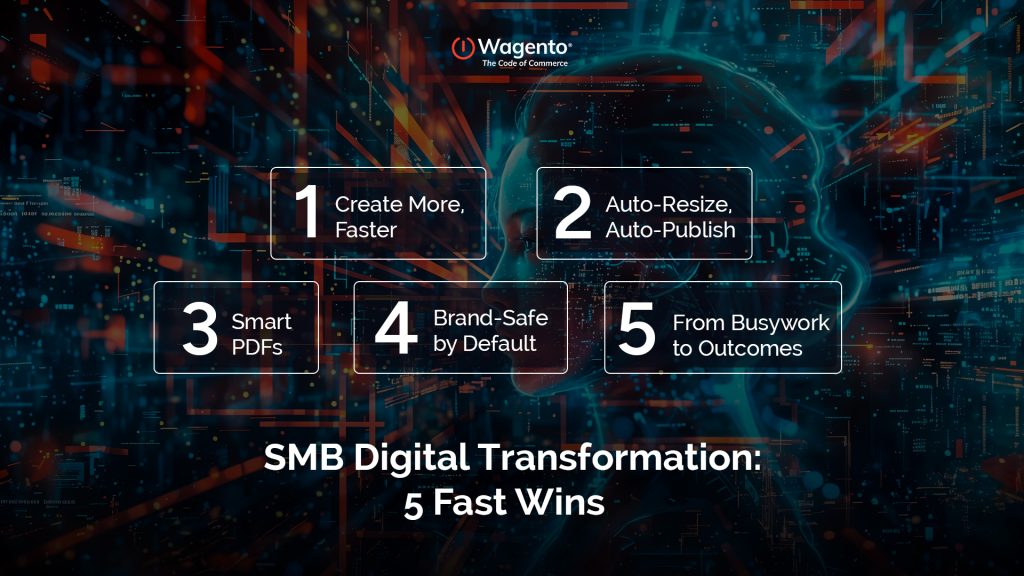
- Adobe Express for SMBs. Create on-brand graphics for ads, social, email, and landing pages. Auto-resize for each channel, keep templates locked to your brand, and hand safe creation tools to non-designers. This is a direct accelerator for ecommerce solutions for SMB growth because it eliminates bottlenecks between ideas and live campaigns.
- Acrobat AI and Acrobat Studio. Summarize vendor PDFs, extract terms into a comparison table, spin up branded proposals, and collaborate in a single hub. Sales, operations, and marketing save time every week, which compounds into more launches and faster deal cycles.
Together these tools push real small business transformation. They standardize quality, reduce rework, and free your team to focus on offers and outcomes rather than formatting and file wrangling.
Adobe Commerce in 2025: Smarter front ends with lower overhead
Modernize the storefront first, then grow into deeper capabilities as revenue scales.
Adobe is investing to make the adobe ecommerce platform faster to ship and easier to maintain. With a modern Commerce storefront approach, merchants can upgrade the front end without a risky back-end rip-and-replace. Built-in testing lets marketers adjust copy, layouts, and promotions without opening tickets, so you can chase conversion gains weekly instead of quarterly.
For adobe commerce development for SMBs, this is the sensible path. Launch a high-impact storefront, connect it to your existing catalog and order flows, and start shipping experiments. As results stack up, expand capabilities in waves rather than trying to do everything on day one.
Orchestrate journeys that adapt in real time
Personalization improves when content velocity, live signals, and approvals work together.
Manually built flows age quickly. Adobe’s journey tools use AI to watch live behavior and propose small, high-frequency improvements. Headlines change based on referrer. Offers adapt for first-time visitors versus account buyers. Tests start with a clear goal and redistribute traffic automatically as winners emerge.
Governance remains central. You set guardrails for brand voice, discounts, regions, and privacy. The system stays within those limits while it works to lift conversions. This model fits both consumer storefronts and adobe b2b commerce, where buyer roles, account pricing, and quotes add complexity that used to demand custom code.
The Content Supply Chain: GenStudio, Firefly, and creative velocity
You cannot personalize what you cannot produce. Adobe’s content supply chain connects idea to activation.
GenStudio turns a single brief into multichannel assets that stay on brand. Firefly speeds variant creation for PDPs, promos, and localizations. Brand settings keep tone and rights intact, so velocity does not erode quality. When the content engine is connected to Commerce and journey tools, you can test more often, retire losers faster, and redirect spend to the winners.
This is where adobe solutions for small businesses shine. Even a lean team can produce enough high-quality creative to feed paid and organic channels, which unlocks steady gains in click-through, add-to-cart, and checkout.
Adobe B2B Commerce: Built for complex buying
B2B buyers expect B2C ease with B2B controls. Adobe Commerce delivers both.
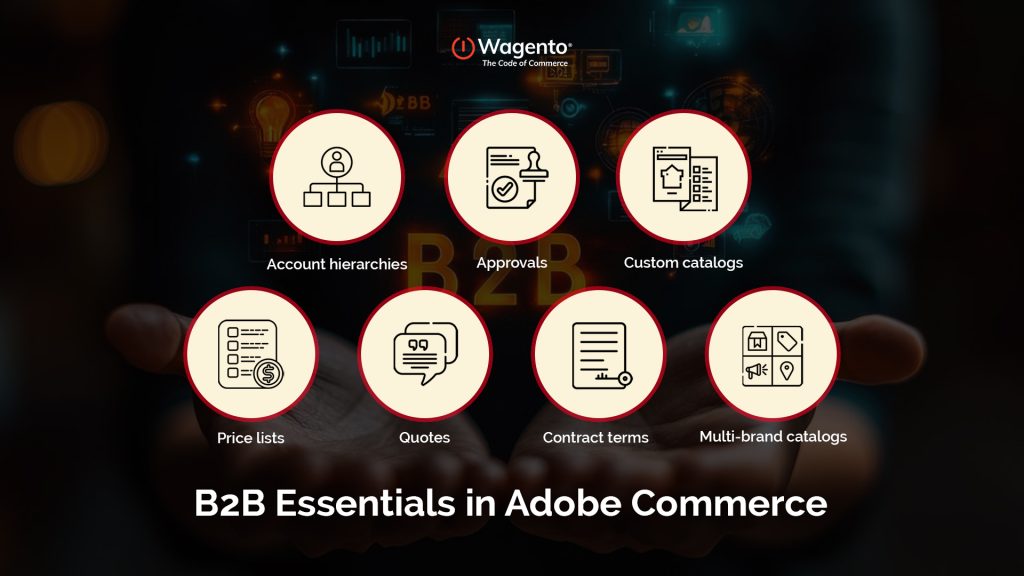
Manufacturers and distributors need buyer-side account hierarchies, approvals, custom catalogs, negotiated pricing, and quotes. With adobe b2b commerce, those workflows are standard. You can present a clean storefront and still support complex purchasing rules behind the scenes.
For global portfolios, a modern catalog model streamlines multi-brand and multi-region launches. Pair that with AI that proposes content and UX adjustments by buyer segment, and your store gets slightly smarter with every cycle. The result is less custom code, fewer workarounds, and a platform that grows with you.
Choosing Adobe Commerce partners in 2025
The right partner accelerates value from day one by wiring AI, content, and Commerce to outcomes.
What good looks like:
- Content supply chain enablement. Partners configure GenStudio, map brand guardrails, and train your team so assets flow quickly and consistently.
- Growth-first storefronts. They modernize the front end and instrument it for rapid testing, rather than focusing only on a technical rebuild.
- Agentic alignment. They connect AI assistants to real KPIs with clear approvals and budgets, so automation stays within your rules.
- Proven B2B patterns. They implement account hierarchies, catalogs, price lists, and quotes without reinventing basics.
If your shortlist includes certified adobe commerce partners, ask for two things: hands-on experience with 2025 releases and a plan to show measurable gains in the first 90 days.
Adobe Commerce for SMBs: A practical implementation path
Sequence investments to match growth and avoid rework.

Phase 1 — Launch a modern storefront fast
Goal: Increase speed, UX quality, and conversion without destabilizing the back end.
- Upgrade the experience layer first.
- Use built-in testing to improve headlines, layouts, and promo logic.
- Connect essential journeys for welcome, cart recovery, and back-in-stock.
- Establish brand guardrails for content and simple AI proposals.
KPIs: Lighthouse scores, add-to-cart rate, checkout conversion, time-to-publish.
Phase 2 — Expand catalogs and B2B journeys
Goal: Support more SKUs, roles, and regions without chaos.
- Introduce account structures, custom catalogs, and quotes for priority buyers.
- Model catalogs for multi-brand, multi-region, or channel partners.
- Let AI tailor messages for role and region within your limits.
- Add source-based personalization for key traffic segments.
KPIs: B2B conversion, quote acceptance, AOV by segment, regional launch speed.
Phase 3 — Close the loop with a content supply chain
Goal: Eliminate bottlenecks between brief, asset, and activation.
- Move campaign briefs into GenStudio with approval workflows.
- Generate localized variants with Firefly and publish to Commerce.
- Use journey tools to auto-test creative and feed results back to AI.
- Shift from ticket queues to governed creation that more teammates can use.
KPIs: Time-to-launch, asset throughput, variant win rate, revenue per campaign.
Six high-impact AI plays to ship this quarter
Low-risk ideas that fit both SMB and enterprise roadmaps.
- Traffic-source personalization. Tailor home and category headlines by referrer to lift relevance within days.
- Goal-based experiments. Declare a conversion target, approve an experiment plan, and let testing run without tickets.
- One brief, many assets. Turn a single product or promo into on-brand variants for PDP, email, and social.
- Checkout focus. A/B test micro-copy, payment options, and trust signals. Prioritize ideas that reduce friction for first-time buyers.
- Quote assist. In B2B flows, suggest cross-sell and contract-friendly bundles during quoting, with human approval.
- Localized merchandising. Create region-specific creative and alt text, then measure impact on organic clicks and conversion.
Metrics that matter – Proving ROI in 2025
Connect AI to four universal levers and instrument the stack to show weekly progress.
- Speed to market. Track time from brief to live campaign. GenStudio and Firefly should reduce hours, not just tasks.
- Conversion and revenue. Report wins by new vs returning buyers, geo, and buyer role. Tie each win to a specific test or AI proposal.
- Personalization depth. Measure the uplift from source-aware and role-aware experiences versus static control groups.
- Brand safety and compliance. Review a weekly log of AI proposals and content approvals. Keep a short list of no-go rules the system cannot cross.
These four lenses keep teams accountable and give executives a clear view of how adobe commerce solutions and AI improve outcomes, not just outputs.
Frequently Asked Questions
It is goal-driven and connected. Instead of one-off prompts, you set a target and the system proposes experiments, content, and UX adjustments within your brand and budget guardrails.
Not if you phase it. Start with a storefront uplift and built-in testing. Add B2B features, catalogs, and integrations as revenue grows. That is the practical route to adobe commerce for SMBs without overreach.
Track lead times and output. A healthy pipeline ships more high-quality assets per week, feeds more tests, and retires losing variants quickly. The outcome is steady gains, not sporadic spikes.
Prioritize certified adobe commerce partners who can show recent hands-on work with AI assistants, storefront modernization, and B2B patterns. Ask for a 90-day plan tied to KPIs, not just a list of deliverables.
Choose two revenue-adjacent goals, define guardrails, and launch a storefront uplift with a simple testing plan. Add journey personalization and content automation once you see early wins.
Conclusion — Make 2025 the year AI becomes your operating advantage
The organizations that win are connecting goals to agentic AI, storefront speed, and governed content at scale.
Adobe’s approach lets you move fast without losing control. For SMBs, Express and Acrobat AI reclaim hours and raise quality. For B2B leaders, Commerce, journey tools, and the content supply chain bring scale without piling on headcount. Tie each initiative to a clear KPI, review proposals weekly, and grow your investment in measured steps.
Treat AI as a managed system and the adobe ecommerce platform evolves into a predictable growth engine. That is how adobe commerce solutions turn into everyday results, how adobe commerce development for SMBs pays back quickly, and how ecommerce solutions for SMB growth compound over time.