


















Imagine you are shopping online late at night. You find a product that interests you but hesitate because you have questions and want to compare options. Suddenly, an AI sales agent appears and answers your questions instantly. It suggests better alternatives based on your preferences and even offers a special discount to help you decide. Without leaving the site or waiting for help, you confidently complete your purchase.
This scenario is no longer science fiction. It is the new reality brought by agentic commerce. Agentic commerce uses intelligent AI agents that act autonomously on your behalf to guide, support, and personalize your shopping experience. These AI agents remove barriers and speed up decisions for shoppers like you, helping ecommerce businesses increase conversion rates by 30 to 40 percent.
As a business owner or marketer, understanding and adopting agentic commerce can transform how you engage customers and boost sales. This blog will explain what agentic commerce is, how it works, why it drives such significant improvements, and how you can leverage it to grow your ecommerce success.
So, here’s the truth:
We know that conversion rate optimization remains a top priority for eCommerce businesses. Increasing the percentage of visitors who become paying customers directly impacts revenue and growth. A new technological breakthrough, agentic commerce, now offers an opportunity to increase conversion rates by 30 to 40 percent. This blog will explain what agentic commerce is, how it works, why it drives such significant improvements, and how businesses can benefit by adopting it.
What Is Agentic Commerce?
Agentic commerce combines artificial intelligence (AI) with autonomous decision-making agents that act on behalf of the shopper in eCommerce environments. Unlike traditional AI tools that assist indirectly or require human direction, agentic commerce uses smart AI agents that independently analyze user behavior, make real-time decisions, and take action toward completing purchases or enhancing customer engagement.
These AI agents function across the entire customer journey by understanding shopper preferences and intent, reducing friction points, and dynamically personalizing interactions to meet each individual’s needs. Through this autonomous and proactive approach, agentic commerce bridges the gap between product discovery and purchase, creating a smoother path to sales.
Key Differences: Agentic Commerce vs. Traditional AI in eCommerce
While many eCommerce brands already use AI for recommendations, chatbots, or predictive analytics, agentic commerce stands apart. The difference lies in autonomy and proactivity. Instead of waiting for instructions, agentic AI acts on its own to solve shopper challenges in real time.
| Traditional AI in eCommerce | Agentic Commerce |
| Provides suggestions but requires human prompts | Makes autonomous, real-time decisions |
| Reactive — responds when asked | Proactive — anticipates needs and engages first |
| Works in isolated touchpoints (chat, recommendations) | Operates across the entire journey seamlessly |
| Improves processes indirectly | Directly drives conversions by removing friction |
This shift is what makes agentic commerce so powerful: it doesn’t just assist customers; it actively helps them buy.
Why Does Agentic Commerce Improve Conversion Rates?
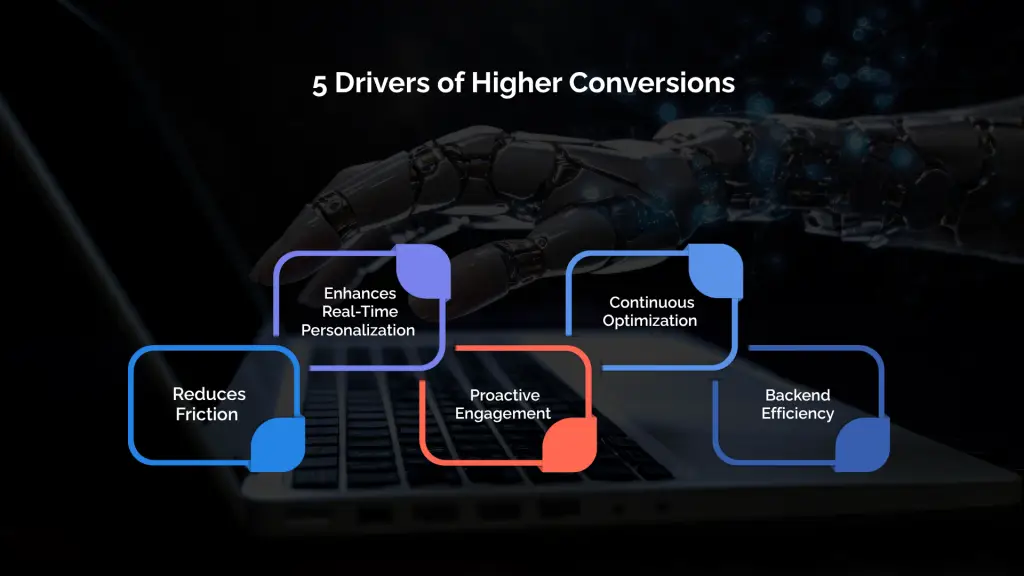
Conversion rates in eCommerce typically hover around 2 to 3 percent, leaving vast room for growth. Agentic commerce increases conversion rates by acting decisively and intelligently in ways that traditional automated processes cannot match. Here is why it delivers such powerful results:
Reduces Friction in the Buying Process
Agentic AI removes obstacles between search and checkout by instantly delivering relevant, trustworthy product information. Shoppers no longer waste time endlessly scrolling, browsing, and comparing. The AI agents autonomously find the ideal products faster, which reduces drop-offs and abandoned carts. For example, by optimizing product listings to be easily understood by AI, brands ensure their products get recommended to the right buyers at the right time, speeding up decisions.
Enhances Personalization in Real Time
Every customer receives a uniquely tailored experience from start to finish. Agentic AI continuously learns from every interaction, purchase history, and contextual signals like location or time of day. This deep personalization prompts smarter product recommendations, custom landing pages, and targeted promotions that resonate and motivate buyers to act quickly. Shoppers feel understood and catered to directly, which builds trust and loyalty.
Powers Proactive Engagement
The AI agents monitor user actions, predict needs, and intervene proactively. For instance, if an agent detects shopping cart hesitation, it can offer instant chat assistance or personalized discounts. Agents also alert businesses about shifting trends and customer behavior changes, allowing marketing teams to respond instantly with optimized campaigns. This timely, targeted approach increases the likelihood of conversion.
Automates and Optimizes Continuously
Traditional conversion rate optimization relies heavily on manual testing and adjustments. Agentic commerce uses sophisticated autonomous A/B testing and performance intelligence frameworks to continuously analyze and implement winning variations. This speeds up learning and scales improvements faster than manual methods. AI agents adapt dynamically to evolving customer preferences without constant human oversight.
Improves Operational Efficiency
Agentic AI also drives backend efficiencies that indirectly support higher conversion rates. It automates repetitive tasks such as catalog management, tagging inventory, and fraud detection. This reduces errors and frees teams for more strategic work while ensuring smooth customer-facing processes like order fulfillment and support.
Evidence of Conversion Uplift: Real-World Results
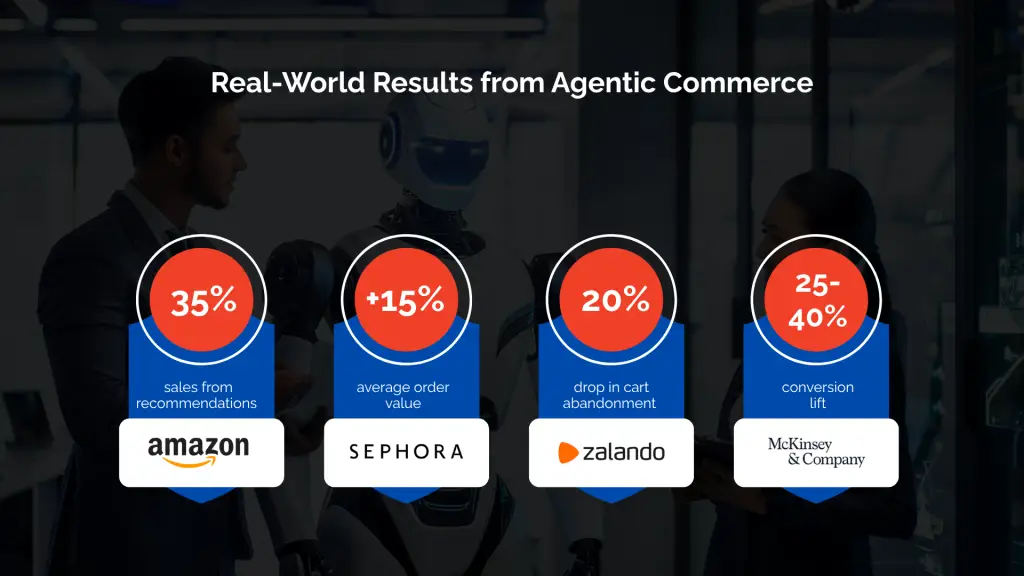
Numerous industry leaders and case studies demonstrate the conversion improvement potential of agentic commerce:
- Amazon’s dynamic recommendation engine uses agentic AI to optimize product suggestions in real time, fueling approximately 35% of its total sales through conversion lifts.
- Sephora’s AI-powered virtual beauty advisors guide shoppers with personalized recommendations via chatbots, resulting in a 15% increase in average order value.
- Zalando deploys agentic AI for AI-driven pricing and promotions, achieving up to 20% reduction in cart abandonment during peak campaigns.
- A McKinsey study found companies using agentic AI in sales strategies saw conversion rate increases averaging 25%, with some reaching 30-40%.
- Research shows AI agents reduce customer service response times by 40%, enhancing satisfaction and contributing to repeat purchases.
These examples prove agentic commerce delivers measurable business gains, including substantial boosts in buying actions.
Leading Companies Pioneering Agentic Commerce
Below are several high-profile eCommerce and retail giants already deploying—or actively experimenting with—agentic AI agents in ways that illustrate the future of autonomous commerce.
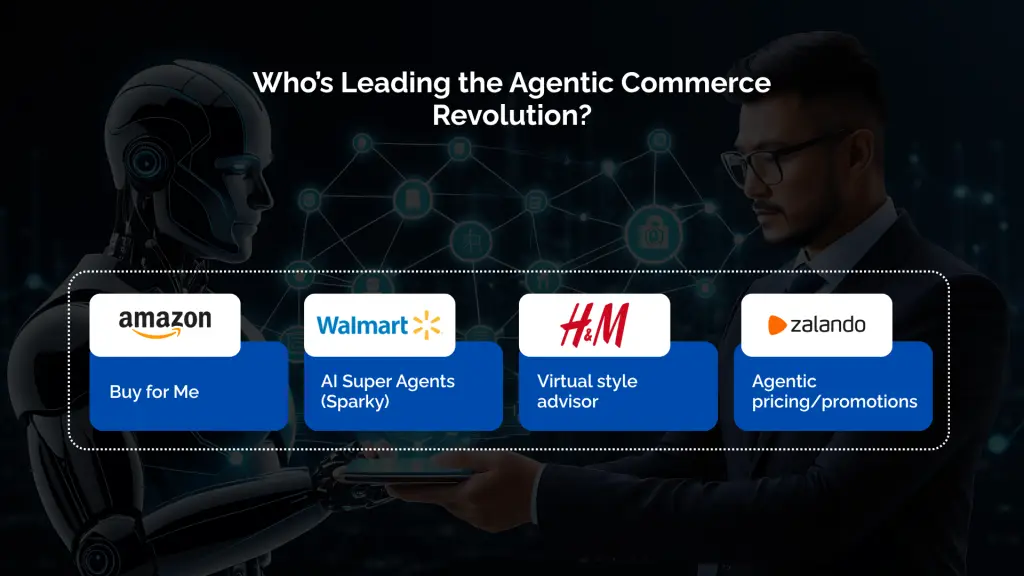
Amazon — “Buy for Me”: Shopping Autonomously, Within the App
Amazon is testing a new AI-powered feature called “Buy for Me”, which enables users to purchase products from third-party brand websites without leaving the Amazon Shopping app.
- When you browse for something not sold directly by Amazon, you may see a “Buy for Me” option. Instead of redirecting you, the AI agent completes the purchase on your behalf—filling in payment and shipping details securely.
- After checkout, you’ll receive an order confirmation from the brand, and you can track it via Amazon’s app. Customer service, returns, and delivery remain managed by the brand itself.
- Amazon states that the “Buy for Me” feature is powered by Amazon Bedrock and foundation models including Nova and Anthropic’s Claude.
- In effect, this is a real-world application of agentic commerce: the AI acts autonomously within defined boundaries to drive conversion, minimize friction, and keep the customer in Amazon’s ecosystem.
This move signals Amazon’s ambition to go beyond “recommendation” and into “action”—where the AI doesn’t just suggest, but executes.
Walmart — The Rise of “Super Agents” & Sparky
Walmart is actively consolidating its AI capabilities into a structured, agentic framework centered around “super agents”.
Key Highlights
- In June 2025, Walmart launched Sparky, a generative AI assistant in the Walmart mobile app that helps customers by summarizing product reviews, comparing options, and offering contextual recommendations.
- But Sparky is only one part of the larger vision. Walmart is folding dozens of prior standalone AI tools into four unified super agents, each serving a distinct stakeholder group (customers, employees, suppliers/advertisers, and internal developers) using a shared protocol.
- These super agents will communicate seamlessly with backend systems—inventory, logistics, pricing, supply chain, enabling context-aware and autonomous actions across the retail ecosystem.
- Futures roadmap: Sparky is expected to evolve from answering questions to performing agentic functions like automatic reordering, event planning, and personalized shopping journeys that respond proactively to a shopper’s context.
By centralizing AI into super agents, Walmart aims to create a more coherent, less fragmented intelligence backbone that can deliver proactive shopping experiences and operational efficiencies simultaneously.
Other Retail & Fashion Brands (Emerging Moves)
While Amazon and Walmart are among the most visible, other major retailers are also laying early groundwork in agentic commerce:
- Zalando is employing dynamically adaptive AI in pricing and promotions to reduce cart abandonment and drive conversions, which aligns with agentic principles (autonomous pricing adjustments).
- H&M has deployed AI-assisted virtual shopping agents to guide customers through style choices, product discovery, and purchase decisions.
- Several luxury and direct-to-consumer brands are experimenting with AI shopping assistants that act not just as search aids but as decision-driving agents.
Who’s Leading the Agentic Commerce Revolution?
Adopting agentic commerce requires strategic planning, solid technology infrastructure, and attention to user experience. Here are key steps to get started:
Optimize Product Listings for AI
Ensure product data, from titles to descriptions, specifications, images, pricing, and availability, is clean, structured, and formatted for easy AI parsing. This enables agents to assess and present product information reliably, which builds shopper trust and speeds decision-making.
Leverage AI-Driven Personalization Tools
Integrate AI systems that learn customer behavior across channels and can deliver personalized content, landing pages, and recommendations in real time. Focus on building autonomous agents capable of adapting continuously to new data.
Automate Conversion Funnel Testing
Use agentic AI solutions that perform autonomous A/B testing, analyze outcomes, and implement winning variants without constant human input. This accelerates funnel optimization to maximize conversions faster.
Enhance Customer Interaction with AI Agents
Deploy chatbots and virtual assistants designed for proactive engagement that provide instant help, personalized offers, and seamless support throughout the shopping journey.
Monitor Data Privacy and Trust
Build comprehensive data security and privacy frameworks that empower first-party data collection while safeguarding customer information. Transparent privacy practices are critical for customer confidence in AI-driven commerce.
Train Teams on AI Ecosystems
Educate marketing, sales, and support teams on new workflows involving AI agents, emphasizing how these tools amplify their capabilities and improve results.
Don’t Let Shoppers Slip Away
Agentic AI keeps customers engaged with instant answers, smart offers, and friction-free checkouts.
KPIs to Measure Success in Agentic Commerce
To ensure agentic commerce delivers measurable value, businesses should monitor these key metrics:
- Conversion Rate Uplift — Direct measure of how many more visitors become customers.
- Average Order Value (AOV) — Tracking upsells and cross-sells driven by AI agents.
- Customer Lifetime Value (CLV) — Measuring how proactive engagement increases repeat purchases.
- Cart Abandonment Reduction — Agents intervene before shoppers drop off.
- Response & Resolution Times — Faster support = higher satisfaction and loyalty.
Clear KPIs make it easier to prove ROI and refine strategies.
Technology Stack Required for Agentic Commerce

To make agentic commerce work effectively, businesses need more than just an AI chatbot on their storefront. It requires a connected ecosystem of technologies that can support autonomous decision-making, real-time personalization, and seamless customer interactions. Below are the key components of the technology stack:
1. AI-Driven Personalization Engines
These engines are the “brains” of agentic commerce. They process customer data and behavior in real time to create tailored shopping experiences.
- Examples: Dynamic product recommendations, customized promotions, adaptive landing pages.
- Value: They reduce irrelevance in shopping journeys, ensuring every visitor sees offers that match intent.
- Tools: Adobe Sensei, Nosto, Algolia Recommend.
2. Customer Data Platforms (CDPs)
A CDP collects, cleans, and unifies customer data from multiple sources (web, mobile, email, in-store). Without it, AI agents lack the full picture of a customer’s intent.
- Examples: Centralizing browsing history, purchase behavior, and engagement signals.
- Value: AI agents can make smarter, contextual decisions when they have a 360° view of the shopper.
- Tools: Segment, Bloomreach, BlueConic.
3. Headless Commerce Platforms
Headless platforms decouple the front-end (what customers see) from the back-end (commerce engine). This flexibility is crucial for agentic commerce because AI agents need to interact across multiple touchpoints — websites, apps, voice assistants, social commerce, and even in-store kiosks.
- Value: Ensures that agents can serve shoppers wherever they are without friction.
- Tools: Adobe Commerce (Magento), BigCommerce, Shopify Plus, Scayle.
4. APIs and Integrations
Agentic commerce thrives on connectivity. APIs allow AI agents to communicate with other systems like:
- Payment gateways (to manage flexible payment options).
- Logistics providers (to give real-time shipping updates).
- CRM/ERP systems (to sync contracts, pricing rules, or inventory).
- Value: Without robust integrations, agents can’t provide the “instant, complete answer” customers expect.
5. Data Security and Privacy Infrastructure
Since agentic AI relies heavily on customer data, businesses must prioritize security.
- Features: First-party data collection, consent management platforms (CMPs), encrypted storage.
- Value: Builds customer trust and compliance with regulations like GDPR, CCPA, or India’s DPDP Act.
6. Automation and Optimization Frameworks
Autonomous A/B testing platforms and performance intelligence tools ensure that conversion optimization is not a one-time setup but a continuous, AI-driven process.
- Examples: Automated funnel testing, dynamic pricing optimization, promotion engines.
- Tools: Optimizely, Dynamic Yield.
Why It Matters
Agentic commerce is not a plug-and-play feature, it’s an ecosystem. The more connected, AI-ready, and flexible your tech stack is, the faster and more effectively your autonomous agents can engage customers. Forward-thinking platforms like Adobe Commerce, BigCommerce, Shopify Plus, and Scayle already provide many of these building blocks, making it easier for businesses to adopt agentic strategies without starting from scratch.
Customer Perspective: Why Shoppers Love Agentic Commerce
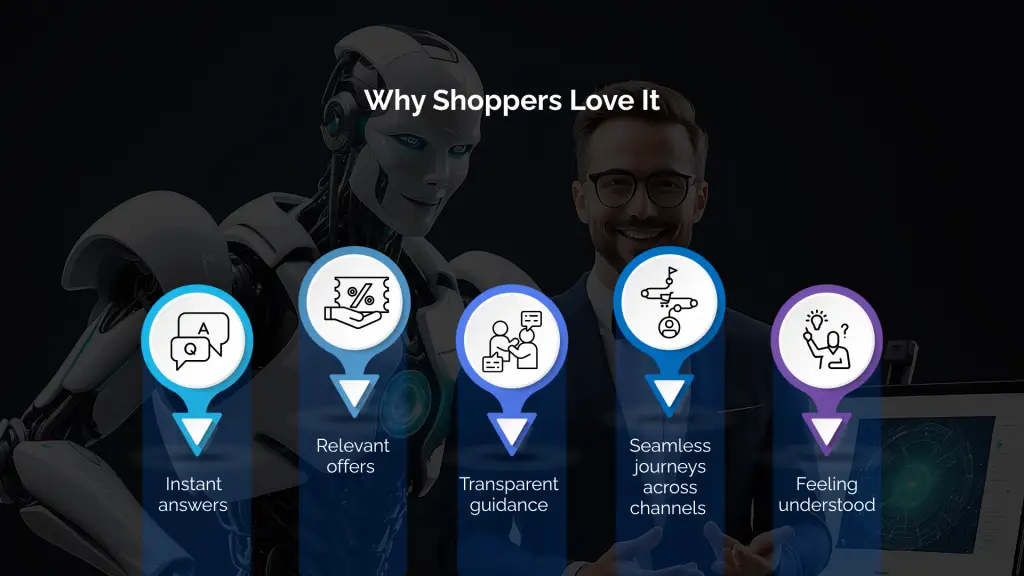
Technology may drive agentic commerce, but the real measure of success lies in how it improves the shopper’s experience. From the customer’s perspective, agentic commerce transforms a complicated, sometimes frustrating buying process into one that feels simple, supportive, and intuitive.
1. Instant Answers and Support
Shoppers don’t like waiting — whether for a live agent in chat or for an email reply. With agentic commerce, questions are resolved on the spot:
- Need size guidance? The AI agent compares fit charts and previous purchase history instantly.
- Curious about product comparisons? It delivers side-by-side details without requiring multiple clicks.
This immediacy reduces hesitation and builds the confidence customers need to complete a purchase.
2. Hyper-Relevant Offers and Recommendations
Unlike generic promotions, agentic AI tailors suggestions to what actually matters to each shopper.
- A returning customer might see a complementary product they’ve browsed before.
- A new visitor could be guided toward bestsellers in their location or price range.
The effect is subtle but powerful — customers feel like the store “gets them,” creating loyalty beyond a single purchase.
3. Confidence Through Transparency
Many shoppers hesitate because they fear making the wrong decision. Agentic commerce addresses this by providing transparent, data-backed guidance.
- If an AI agent recommends a product, it explains why: better reviews, lower price, faster shipping, or higher compatibility.
- This clarity reduces buyer’s remorse and strengthens trust in the brand.
4. Friction-Free Journeys Across Channels
Shoppers today switch between mobile, desktop, social media, and even in-store touchpoints. Agentic commerce ensures the experience stays consistent.
- A product added to a cart on mobile is still there on desktop.
- Discounts or recommendations follow the shopper across channels without confusion.
This continuity feels seamless and natural, keeping shoppers engaged until checkout.
5. A Feeling of Being Understood
Ultimately, shoppers love agentic commerce because it makes them feel seen and valued. Instead of a one-size-fits-all sales approach, they receive experiences that match their preferences, timing, and needs. This emotional connection is what transforms one-time buyers into repeat customers.
Scale Smarter, Not Harder
From SMEs to enterprise, agentic commerce helps you grow without adding complexity.
Challenges & Risks of Agentic Commerce
Adopting agentic commerce comes with hurdles businesses must address:
- Data Privacy Concerns → AI agents rely on customer data to work effectively, making secure handling and compliance essential.
- AI Overreach → If agents act too aggressively (e.g., pushing discounts too often), customers may feel pressured rather than supported.
- Customer Trust → Transparency in how recommendations are generated and prices are set is critical to building long-term confidence.
Brands that strike the right balance between automation and human oversight will capture the benefits without risking trust.
How Small and Mid-Sized Businesses Can Benefit
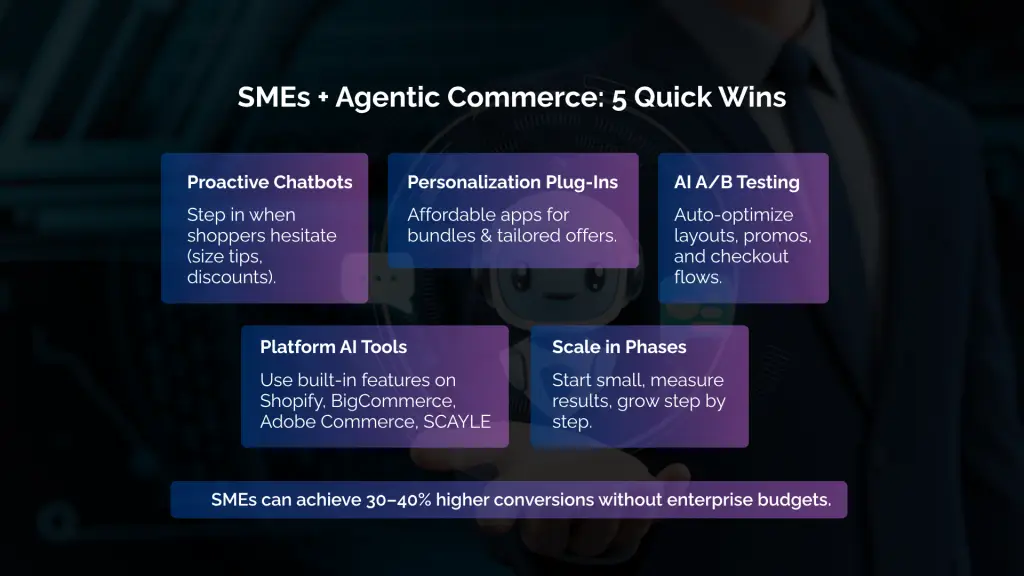
Agentic commerce is often associated with global giants like Amazon or Walmart, but it’s not limited to enterprises with massive budgets. Small and mid-sized businesses (SMEs) can also take advantage of agentic AI to improve conversions and customer experience without a heavy upfront investment. The key is to start lean, use scalable tools, and adopt a phased approach.
1. AI-Powered Chatbots that Act Proactively
Instead of waiting for customers to click a “Help” button, AI chatbots can proactively step in when a shopper lingers on a page or hesitates at checkout.
- Example: A small apparel store can deploy an AI chatbot that notices when a shopper pauses at the size chart and immediately offers personalized fit guidance or free shipping incentives.
- Benefit: Increases conversion while reducing abandoned carts without needing a large customer support team.
2. Affordable Plug-Ins for Personalization and Bundling
Many eCommerce platforms now offer lightweight plug-ins that introduce agentic features.
- Example: A Shopify merchant can install a plug-in that recommends complementary products based on browsing behavior or automatically creates bundles at discounted prices.
- Benefit: SMEs can offer the same type of personalized shopping experience as bigger brands, boosting average order value with minimal technical setup.
3. Cloud-Based A/B Testing with AI Optimization
Conversion rate testing used to require constant manual setup and monitoring, which many SMEs don’t have time for. Agentic commerce solutions now handle this autonomously.
- Example: A mid-sized electronics store can run AI-driven tests on product page layouts, promotions, and checkout flows with the system automatically pushing the highest-performing variations live.
- Benefit: Continuous optimization without hiring specialized CRO experts.
4. Leverage Existing Platform Capabilities
SMEs don’t need to build custom agentic systems. Platforms like Shopify Plus, BigCommerce, Adobe Commerce, and Scayle already integrate AI-powered tools into their ecosystems.
- Benefit: Businesses can tap into enterprise-grade AI features at a fraction of the cost, scaling as they grow.
5. Phased Adoption Approach
The best strategy for SMEs is to start small, measure results, and scale gradually.
- Phase 1: Add proactive chatbots.
- Phase 2: Introduce product personalization and bundling.
- Phase 3: Expand into AI-driven testing and multi-channel automation.
This staged approach ensures improvements in conversion are achieved without overextending resources.
Agentic commerce levels the playing field. With affordable, modular tools, SMEs can give customers the same seamless, personalized, and proactive buying journey that large enterprises deliver. By starting small and scaling smartly, SMEs can unlock the same conversion gains, with 30–40% uplifts, without needing enterprise-level budgets or teams.
The Future of Commerce Is Agentic
Agentic commerce is set to reshape retail by creating intelligent, autonomous buying journeys that improve customer experiences while boosting business performance. By reducing buying friction, personalizing at scale, and optimizing conversion funnels continuously, agentic commerce can increase conversion rates by as much as 30 to 40 percent. This gives ecommerce brands a powerful advantage in an ultra-competitive landscape.
Brands ready to leverage agentic commerce will enable faster sales, deeper customer relationships, and more agile marketing. Businesses that adopt this technology now will outpace competitors by delighting shoppers with AI-powered experiences built for speed and relevance.
In conclusion, agentic commerce represents a transformational leap forward in ecommerce capability. It empowers businesses to convert more visitors into loyal customers through proactive, intelligent automation that adapts in real time. Embracing agentic commerce will not only increase conversion rates significantly but also future-proof ecommerce enterprises for sustained growth.
Agentic Commerce Readiness Checklist
Are you ready to implement agentic commerce in your business? Review this checklist:
- Product data is clean, structured, and AI-readable.
- Privacy and security frameworks are in place.
- AI tools and personalization systems are connected.
- Teams are trained to work with AI-assisted workflows.
- Success metrics (KPIs) are defined and monitored.
If most boxes are ticked, you’re ready to begin leveraging agentic commerce for real growth.
Is Your Business AI-Ready?
Use our readiness checklist to see if your store can harness the power of agentic commerce.
FAQs
Agentic commerce is an approach to eCommerce that uses autonomous AI agents to guide, support, and personalize shopping experiences. Unlike traditional automation, these AI agents act proactively — answering questions, making recommendations, and even completing parts of the buying process to reduce friction and increase conversions.
Agentic AI in e-commerce improves the customer journey by:
Delivering instant answers to product or checkout questions
Offering personalized recommendations in real time
Reducing cart abandonment with proactive engagement
Continuously optimizing the sales funnel with autonomous A/B testing
The result is smoother shopping experiences and higher conversion rates.
E-commerce agents are intelligent AI systems that interact with shoppers across the buying journey. They can act as virtual sales assistants, product advisors, or checkout guides — ensuring customers get the right information and support at the right time.
Several agentic commerce companies are pioneering this approach:
Amazon with its “Buy for Me” feature
Walmart with its “Sparky” AI super agent
Zalando with AI-driven pricing and promotions
Hu0026M with virtual style advisors
These examples show how agent-mediated e-commerce is already reshaping the market.
For Shopify agentic commerce adoption, merchants can start with:
AI-powered chatbots that step in when customers hesitate
Personalization plug-ins for bundles and recommendations
Cloud-based A/B testing tools that optimize product pages
Some agencies also provide Shopify agentic commerce evaluation services to assess readiness and recommend integrations.
Yes. Adobe enterprise eCommerce software such as Adobe Commerce (Magento) supports AI-powered personalization, product recommendations, and integrations with agentic systems. An Adobe agentic commerce evaluation can help brands understand how to combine Adobe’s platform with autonomous AI agents for higher conversion.
Yes. BigCommerce agentic commerce evaluation often highlights its strong API-first architecture and support for AI personalization tools. This makes it easier for AI agents to connect with product catalogs, payments, and third-party integrations.
Kibo Commerce agentic commerce integration focuses on headless and modular commerce, enabling AI agents to interact across channels.
Stripe agentic commerce adoption is growing, with AI agents using its payments APIs to handle transactions securely and instantly.
SMEs can use agentic e-commerce without heavy costs. They can start small with:
AI chatbots
Product personalization apps
Built-in platform AI tools on Shopify, BigCommerce, or Adobe Commerce
This phased adoption helps smaller businesses unlock the same 30–40% conversion gains as enterprises.
Agent-mediated e-commerce is the concept of letting autonomous agents handle parts of the buying process — from finding products and negotiating offers to completing checkout steps. This model is at the core of agentic commerce, where AI reduces the manual effort required by both customers and merchants.