



















Ai-first eCommerce is not an industry disruption, it is created by customers, end users and avid buyers and now brands have to match that expectation.
Ana wanted to surprise her husband with a pair of high-end, stylish eyewear for his birthday. But there was one small problem, she knew next to nothing about eyewear brands, frame types, face shapes, or lens coatings. A quick scroll through a traditional eCommerce site left her overwhelmed with filters and jargon she didn’t understand.
Instead of continuing down the rabbit hole of endless categories and confusing specs, Ana tried something different, she asked an AI.
She opened ChatGPT, and typed…
“I want to buy eyeglasses”
In seconds, the AI responded with tailored suggestions—not just products, but recommendations based on face shape, current fashion trends, UV protection levels, and even brands that aligned with minimalist style. It walked her through options, explaining why certain frames worked better than others, and even offered insights.
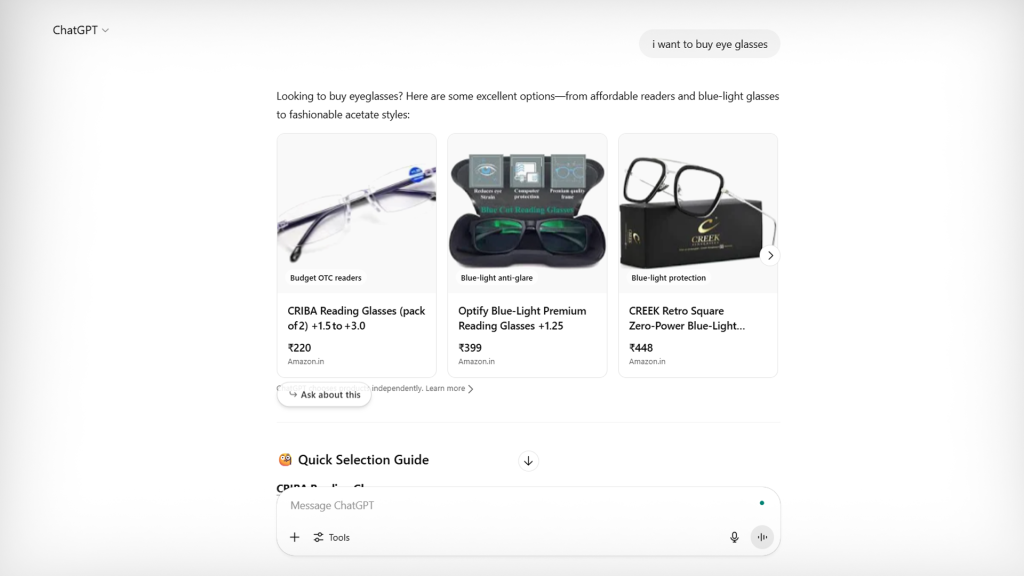

Ana never had to navigate dozens of dropdowns or decipher specs. The AI cross-referenced real-time inventory, customer reviews, and price history to suggest the best time to buy.
What Changed?
This wasn’t just a smarter product search. It was a personalized, consultative buying experience—something that used to be exclusive to high-end retail in stores and online.
With AI and ChatGPT:
- The buyer journey became interactive instead of static.
- Decision-making was accelerated by intelligent guidance.
- Confidence replaced confusion—thanks to real-time, human-like answers.
The Big Picture
Ana’s experience is a glimpse into a larger disruption unfolding across the eCommerce ecosystem. AI-first platforms are reimagining the buyer journey—not by simply automating what we used to do manually, but by making commerce conversational, predictive, and incredibly personalized.
No more guessing. No more endless clicks. Just the right product, at the right time, for the right person.
Welcome to the future of buying.
The eCommerce landscape is experiencing a seismic shift. While traditional B2B companies have been slow to adopt digital transformation, a new generation of AI-first platforms is revolutionizing how businesses source, purchase, and manage their supply chains. This isn’t just about digitizing catalogs or automating orders—it’s about creating intelligent ecosystems that anticipate business needs and optimize entire value chains.
July 18, 2025
Source: LinkedIn
OpenAI explores eCommerce tools
By James Callan, Editor at LinkedIn News
OpenAI is stepping up efforts to tap new revenue streams. The artificial intelligence startup plans to embed a checkout system into ChatGPT and will receive a share of product sales made directly through the platform, The Financial Times reports, citing anonymous sources. While premium subscriptions remain its main source of revenue, OpenAI has been exploring new avenues to generate sales, including announcing a partnership with Shopify in April. Earlier this year, the company hired Fidji Simo, the CEO of Instacart, as head of applications.
What is AI-First eCommerce?
AI-first eCommerce fundamentally reimagines business commerce by placing artificial intelligence at the center of every transaction, relationship, and operational decision. Unlike traditional B2B platforms that treat AI as an add-on feature, these systems are architected from the ground up to leverage machine learning, predictive analytics, and intelligent automation.
In the B2B context, this means platforms that understand complex procurement cycles, negotiate pricing dynamically, predict inventory needs across multiple business customers, and manage intricate supplier relationships—all while learning and adapting to market conditions in real-time.
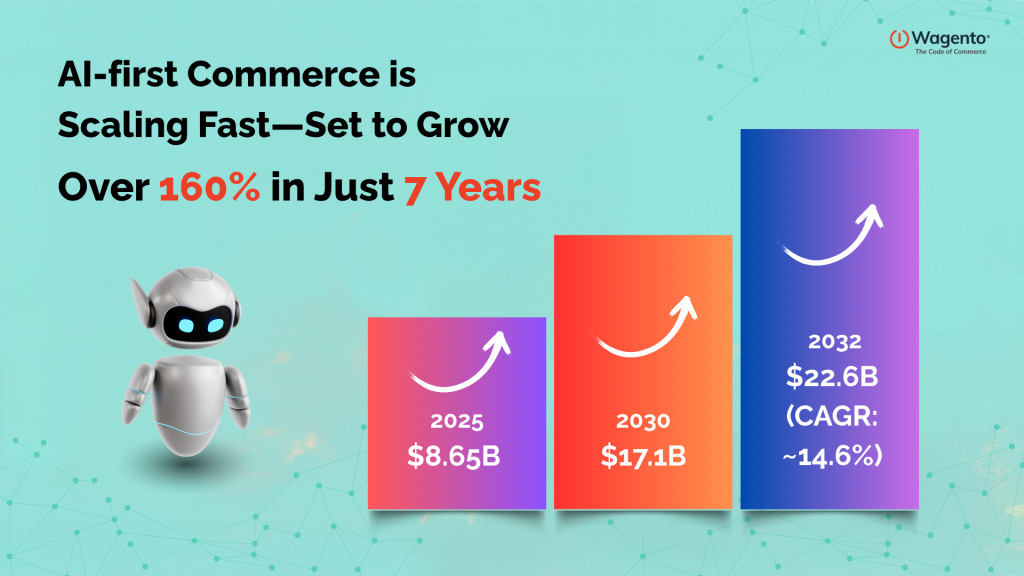
Global AI‑enabled eCommerce market size is projected to reach US $8.65 billion in 2025, growing to $17.1 billion by 2030, and further to $22.6 billion by 2032, with a CAGR of ~14.6% between 2024–2032
AI in the Complete Business Journey
We know AI is everywhere but where exactly?
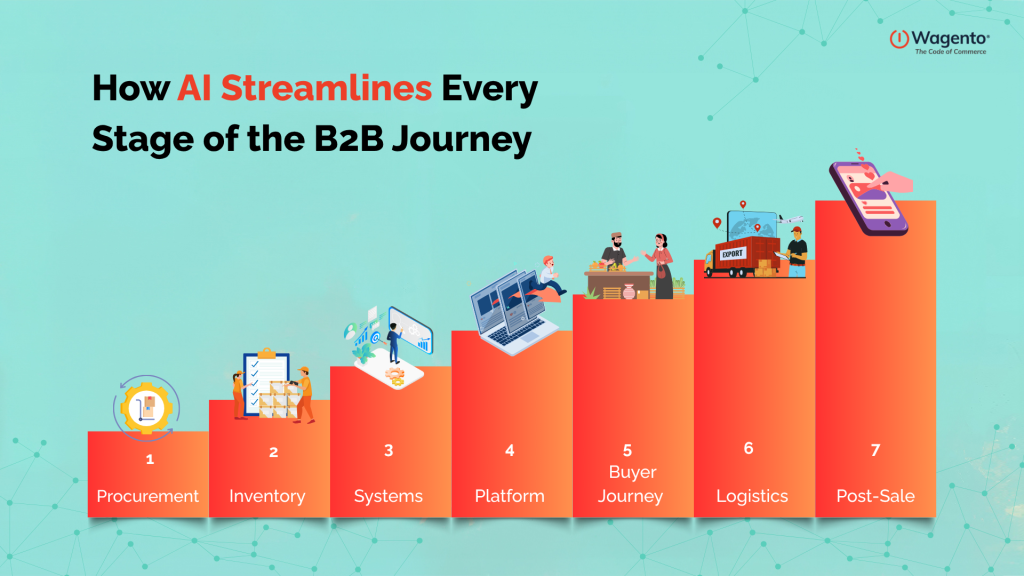
Let’s explore how Artificial Intelligence for eCommerce is transforming every stage of the B2B business journey—from the initial sourcing of suppliers to post-sale customer retention. By examining each phase of the end-to-end B2B flow, this study demonstrates how AI integrates seamlessly into operations, automates complex processes, enhances customer experiences, and drives measurable performance improvements. Whether it’s predicting demand, managing inventory, personalizing content, or optimizing logistics, AI acts as the central intelligence powering smarter decisions and scalable growth across the entire B2B ecosystem.
The End-to-End Business Flow
1. Sourcing and Procurement
AI-Powered Supplier Discovery: AI analyses market data, supplier performance metrics, and business requirements to identify optimal suppliers. The system evaluates factors like pricing competitiveness, delivery reliability, quality standards, and financial stability to recommend the best sourcing partners.
Intelligent Purchase Planning: AI predicts demand patterns by analyzing historical sales data, seasonal trends, and market indicators. This enables businesses to optimize their procurement timing, quantities, and supplier mix to reduce costs while ensuring adequate inventory levels.
Automated Supplier Negotiations: AI systems can conduct initial negotiations within predefined parameters, analyzing market prices, volume discounts, and payment terms to secure favorable deals. The technology handles routine negotiations while escalating complex scenarios to human decision-makers.
2. Inventory Management and Uploading
Smart Inventory Optimization: AI continuously analyzes sales velocity, seasonal patterns, and market trends to determine optimal inventory levels. The system automatically adjusts reorder points, identifies slow-moving stock, and suggests inventory liquidation strategies to improve cash flow.
Automated Product Data Management: When new inventory arrives, AI automatically processes product information, images, and specifications. The system standardizes product descriptions, categorizes items, and enriches data with relevant attributes, eliminating manual data entry and ensuring consistency.
Dynamic Pricing Intelligence: AI monitors competitor pricing, market demand, and inventory levels to suggest optimal pricing strategies. The system can automatically adjust prices based on stock levels, demand fluctuations, and competitive positioning while maintaining desired profit margins.
3. System Integrations and Operations
ERP and Backend System Integration: AI orchestrates data flow between inventory management systems, accounting software, and customer databases. The system ensures real-time synchronization, prevents data conflicts, and automatically updates inventory levels across all platforms when sales occur.
Supplier API Integration: AI manages complex supplier integrations, automatically processing electronic data interchange (EDI) files, API feeds, and supplier catalogs. The system handles format variations, data mapping, and error resolution to maintain seamless supplier connectivity.
Order Management Automation: AI processes incoming orders, validates inventory availability, checks customer credit limits, and routes orders to appropriate fulfillment centers. The system handles complex order scenarios like partial shipments, backorders, and special requirements automatically.
33% of B2B eCommerce companies in the US have fully implemented AI in their operations, and another 47% are evaluating it—a 270% adoption increase since 2019.
4. eCommerce Platform Management
Intelligent Catalog Display: AI dynamically organizes product catalogs based on customer segments, search patterns, and purchasing behavior. The system personalizes product positioning, suggests cross-sells and upsells, and optimizes category structures for better discoverability.
Search and Discovery Optimization: AI enhances search functionality by understanding customer intent, handling typos and variations, and providing relevant results even for complex technical queries. The system learns from search patterns to improve results over time.
Content Generation and Optimization: AI automatically generates product descriptions, technical specifications, and marketing content tailored to different customer segments. The system ensures consistent messaging while adapting content for various industries and use cases.
5. Customer Journey and Buyer Experience
Personalized Customer Onboarding: AI analyzes new customer profiles, industry requirements, and business size to create customized onboarding experiences. The system recommends relevant products, suggests optimal order quantities, and provides tailored pricing based on customer characteristics. AI customer support chatbots in eCommerce assist throughout the onboarding journey, answering questions in real-time and guiding users through setup processes with conversational ease.
Intelligent Product Recommendations: AI tracks customer behavior, purchase history, and industry trends to provide relevant product suggestions. The system identifies complementary products, suggests alternatives when items are unavailable, and recommends upgrades or bulk purchasing opportunities.
Predictive Customer Service: AI monitors customer behavior patterns to identify potential issues before they escalate. The system proactively reaches out with solutions, provides order status updates, and suggests reorder timing based on usage patterns.
6. Shipping and Logistics Management
Smart Shipping Optimization: AI analyzes order characteristics, destination addresses, and carrier performance to select optimal shipping methods. The system considers factors like cost, delivery speed, reliability, and customer preferences to make intelligent routing decisions.
Automated Carrier Selection: AI evaluates multiple carriers in real-time, comparing rates, transit times, and service quality to select the best option for each shipment. The system can automatically switch carriers based on performance issues or cost fluctuations.
Predictive Delivery Management: AI predicts delivery times, identifies potential delays, and proactively communicates with customers about shipment status. The system can suggest delivery alternatives and coordinate with customers to ensure successful deliveries.
7. Post-Sale Operations and Customer Retention
Intelligent Reorder Predictions: AI analyzes customer consumption patterns, business cycles, and inventory levels to predict when customers will need to reorder. The system proactively reaches out with reorder suggestions and can automate repeat purchases for consumable items.
Customer Lifecycle Management: AI tracks customer engagement, purchase frequency, and satisfaction indicators to identify at-risk customers. The system triggers retention campaigns, suggests service improvements, and identifies opportunities for account expansion.
Performance Analytics and Optimization: AI continuously analyzes business performance across all touchpoints, identifying bottlenecks, optimization opportunities, and growth potential. The system provides actionable insights for improving operations and customer satisfaction.
Integration Benefits Across the Journey
B2B businesses typically operate with multiple disconnected systems – ERP software for inventory management, CRM platforms for customer relationships, accounting systems for financial data, supplier portals for procurement, warehouse management systems for fulfillment, and ecommerce platforms for sales. AI-first platforms serve as the intelligent orchestration layer that connects these disparate systems, creating a unified ecosystem where data flows seamlessly and decisions are made based on comprehensive, real-time information rather than isolated data points.
Seamless Data Flow
AI ensures information flows seamlessly between all systems, eliminating data silos and providing real-time visibility across the entire business operation.
Automated Decision Making
AI handles routine decisions automatically while escalating complex scenarios to human operators, improving efficiency and consistency.
Continuous Learning and Improvement
The system learns from every interaction, continuously improving its recommendations, predictions, and automation capabilities.
Scalable Operations
AI enables businesses to handle increased volume and complexity without proportional increases in operational costs or staff requirements.
Unlock Efficiency at Every Stage of Your B2B Journey
From sourcing to retention, see how AI can reduce manual work by 70% and increase revenue by up to 40%.

Key Performance Improvements After Your eCommerce Becomes AI-First
- Reduced Manual Work: Up to 70% reduction in manual data entry and routine tasks
- Improved Accuracy: 95%+ accuracy in inventory management and order processing
- Faster Response Times: Instant quote generation and customer service responses
- Better Customer Experience: Personalized interactions and proactive service
- Cost Optimization: 15-30% reduction in operational costs through automation and optimization
- Increased Sales: 20-40% increase in revenue through better customer targeting and retention
Companies using AI report 10–12% average revenue increases, and profitability could rise by 59% by 2035.
The Technologies Powering AI-First Platforms
1. Advanced Analytics and Business Intelligence
B2B transactions generate vast amounts of data across procurement cycles, supplier relationships, and market conditions. AI systems analyze this data to provide actionable insights for strategic decision-making, from supplier selection to market expansion opportunities.
2. Natural Language Processing for B2B Communication
NLP enables platforms to process complex RFQs (Request for Quotations), understand detailed product specifications, and facilitate natural language interactions between buyers and suppliers. This technology bridges the gap between technical requirements and available solutions.
3. Machine Learning for Demand Forecasting
Sophisticated algorithms analyze historical purchasing data, market trends, and business cycles to predict demand with remarkable accuracy. This enables better inventory planning, supplier capacity management, and strategic business planning.
4. Intelligent Document Processing
AI automatically processes invoices, purchase orders, contracts, and compliance documents, reducing manual work and ensuring accuracy in complex B2B transactions that often involve multiple stakeholders and approval processes.
Benefits of AI-First eCommerce for B2B Marketplace Operators
B2B marketplace operators face unique challenges that differ significantly from B2C platforms. They must manage complex supplier relationships, handle intricate procurement processes, navigate long sales cycles, and maintain service quality across diverse business customers with varying needs. Traditional B2B operations require extensive manual oversight, from processing detailed RFQs to managing multi-party negotiations and ensuring compliance with industry regulations. AI-first platforms transform these operational challenges into competitive advantages by automating complex processes, providing intelligent insights, and enabling scalable growth without proportional increases in operational overhead.
Scalable Operations
AI automates complex B2B processes that traditionally required significant manual intervention, enabling platforms to scale efficiently while maintaining service quality across thousands of business relationships.
B2B transactions involve intricate workflows from processing complex RFQs to managing multi-tier approval processes. AI-first systems transform this by intelligently automating these sophisticated processes. The system can process buyer requests instantly, match requirements with optimal suppliers, generate competitive quotes, and handle initial negotiations—all simultaneously across thousands of active business relationships. This creates exponential scalability without proportional increases in operational costs.
Enhanced Supplier Network Management
Intelligent systems continuously evaluate supplier performance, identify new partnership opportunities, and optimize the supplier network for better coverage, pricing, and service levels.
AI creates comprehensive supplier profiles tracking delivery performance, quality metrics, pricing competitiveness, and financial stability. The system detects early warning signs of supplier issues, identifies new partnership opportunities by analyzing market trends and customer demands, and recommends optimal supplier mix configurations. This creates a more robust, efficient, and strategically aligned supplier ecosystem.
Improved Customer Retention
By anticipating business needs and providing proactive service, AI-first platforms create stronger relationships with business customers, leading to higher retention rates and increased lifetime value.
AI analyzes historical purchasing patterns, seasonal variations, and business growth indicators to anticipate when customers will need to reorder or require new products. The system personalizes experiences at scale, providing tailored product recommendations and customized pricing based on relationship history. This proactive approach combined with exceptional automated customer service creates switching costs that go beyond convenience.
Data-Driven Market Intelligence
Comprehensive analytics provide insights into market trends, customer behavior, and competitive dynamics, enabling more strategic business decisions and market positioning.
The platform aggregates transaction data, supplier performance metrics, and customer behavior patterns to create comprehensive market intelligence. AI detects subtle market signals, identifies emerging trends in product demand, and spots new customer segments. This intelligence feeds into strategic planning, helping operators identify underserved markets, predict demand for new services, and optimize market positioning strategies.
Benefits of AI-First eCommerce for Business Buyers
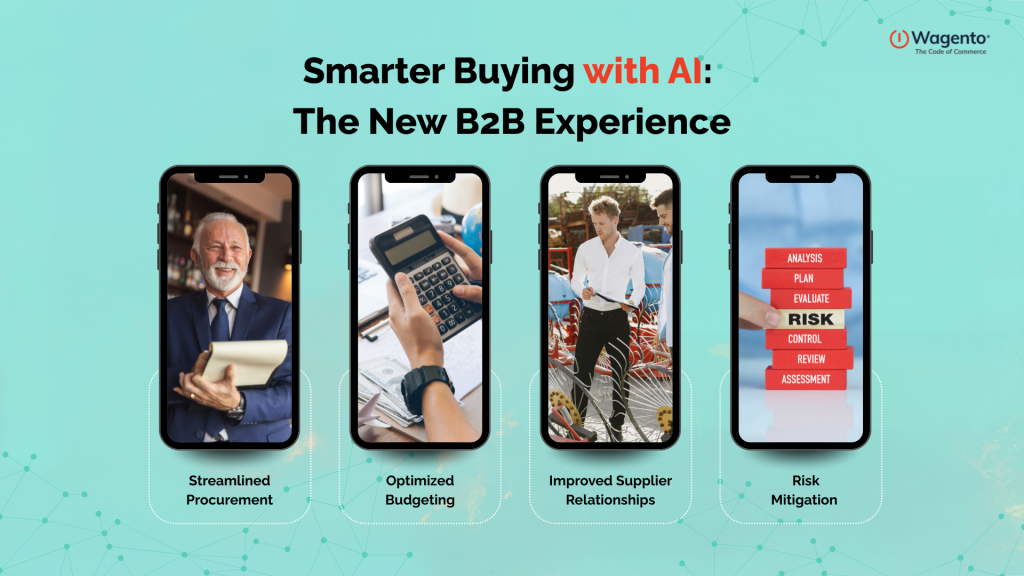
In today’s fast-paced B2B landscape, business buyers expect more than just transactional efficiency—they seek speed, personalization, and strategic value at every step of the buying journey. An AI-first eCommerce approach empowers organizations to meet these expectations by embedding intelligence into the core of their operations. From procurement and budgeting to supplier collaboration and risk management, AI enables smarter decisions, automated workflows, and real-time insights. The result is a streamlined, data-driven experience that not only simplifies purchasing but also unlocks long-term business value and competitive advantage.
Streamlined Procurement Processes
AI transforms traditional procurement by eliminating manual inefficiencies and enabling smarter workflows. Through automation, AI handles repetitive tasks such as vendor selection, purchase order creation, and invoice matching. It manages complex approval hierarchies, enforces policy compliance, and flags exceptions for human review—ensuring speed, accuracy, and governance. As a result, procurement teams are freed from tactical execution and can instead focus on strategic sourcing, supplier innovation, and category management.
AI-powered chatbots are already used or planned by 80% of retail and eCommerce companies, with forecasts suggesting 80% of all customer service requests will be handled by AI by 2030.
Optimized Spending and Budgeting
With advanced predictive analytics, AI enables precise demand forecasting and purchasing recommendations. By analyzing past transactions, seasonality, and usage patterns, it helps procurement teams plan better, consolidate orders, and leverage bulk discounts. AI also monitors payment cycles and supplier terms to suggest optimal timing for disbursements—enhancing cash flow and reducing financial risk. This level of spend intelligence empowers organizations to stay within budget while maximizing value from every purchase.
Improved Supplier Relationships
AI systems act as a bridge between buyers and suppliers, enhancing collaboration and transparency. They track supplier performance indicators such as on-time delivery, order accuracy, and responsiveness, generating objective scorecards that support supplier reviews and contract negotiations. AI also identifies trends and recommends actions to strengthen relationships—such as diversifying sources, co-developing products, or aligning on sustainability goals—fostering long-term strategic partnerships rather than transactional interactions.
Risk Mitigation
AI-powered risk monitoring continuously evaluates internal and external factors that may impact the supply chain. It scans news feeds, financial data, and geopolitical developments to detect early warning signs of supplier instability or market disruption. Internally, AI identifies non-compliance, fraud risks, or process bottlenecks. By surfacing these insights proactively, businesses can take corrective actions before issues escalate—ensuring continuity, protecting margins, and enhancing operational resilience.
Transform the Way Businesses Buy from You—With AI
Join the 33% of B2B businesses already leveraging AI to streamline procurement, improve forecasting, and build smarter supplier relationships.
Benefits of AI-First eCommerce for Suppliers
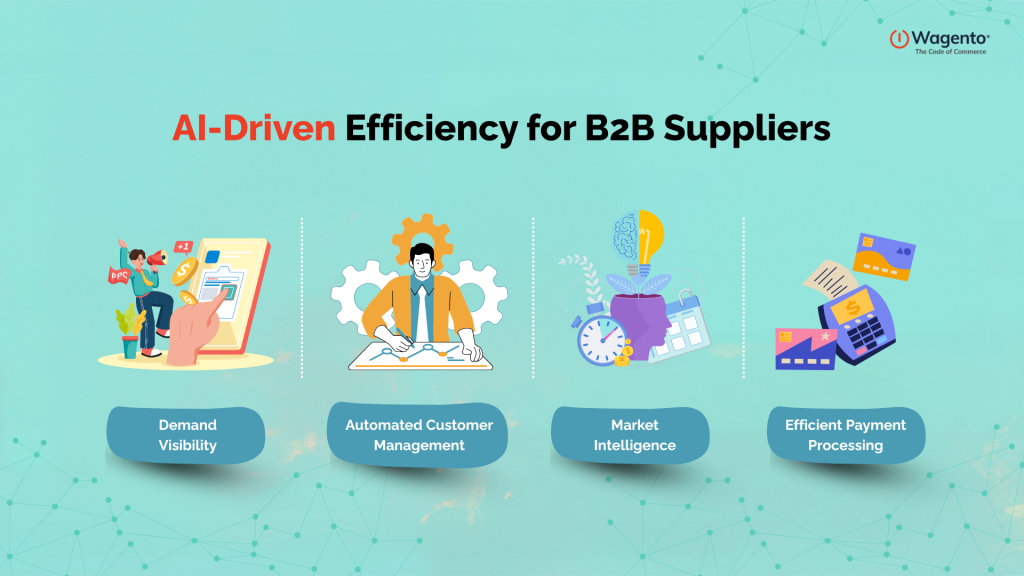
Suppliers in B2B marketplaces face significant operational challenges including demand uncertainty, complex customer relationships, inefficient manual processes, and limited market visibility. They often struggle with unpredictable order patterns, lengthy payment cycles, administrative overhead, and difficulty accessing comprehensive market intelligence. Traditional supplier operations require substantial resources for customer management, order processing, and financial administration. AI-first platforms address these pain points by providing suppliers with intelligent tools that enhance demand forecasting, automate routine operations, deliver valuable market insights, and streamline financial processes, ultimately enabling suppliers to operate more efficiently and grow their businesses strategically.
Demand Visibility and Planning
AI provides suppliers with better visibility into future demand, enabling more accurate production planning and inventory management.
AI analyzes historical purchasing patterns, seasonal trends, and market indicators to provide suppliers with predictive demand forecasts. The system identifies which products are likely to see increased demand, when peak ordering periods will occur, and which customers are most likely to place large orders. This visibility enables suppliers to optimize production schedules, maintain appropriate inventory levels, and avoid costly stockouts or overproduction.
Automated Customer Management
Intelligent systems handle routine customer interactions, process orders efficiently, and provide real-time updates on order status and delivery schedules.
AI manages day-to-day customer communications, automatically acknowledging orders, providing shipping updates, and handling routine inquiries. The system processes orders instantly, validates inventory availability, and coordinates with logistics providers to ensure timely delivery. This automation reduces response times, improves customer satisfaction, and frees up staff to focus on strategic relationship building.
Market Intelligence
Suppliers gain insights into market trends, competitive positioning, and customer preferences, enabling more strategic business development.
AI analyzes marketplace data to provide suppliers with insights into pricing trends, competitor activity, and emerging customer needs. The system identifies opportunities for product development, suggests optimal pricing strategies, and highlights potential new market segments. This intelligence enables suppliers to make informed strategic decisions about product offerings, market positioning, and business expansion.
Efficient Payment Processing
AI streamlines invoicing, payment processing, and accounts receivable management, improving cash flow and reducing administrative overhead.
AI automates invoice generation, tracks payment status, and manages collections processes. The system identifies payment delays, suggests optimal payment terms for different customers, and can even facilitate early payment discounts or financing options. This automation reduces administrative costs, improves cash flow predictability, and minimizes payment-related disputes.
Listen to an AI in eCommerce Podcast.
Leading AI-First eCommerce Platforms and How They Work
AI-first eCommerce platforms are transforming the landscape of digital commerce by placing artificial intelligence at the core of how online businesses operate. These platforms go beyond automation — they think, learn, and adapt to create highly personalized, data-driven, and scalable experiences for both B2B and B2C commerce.
Here’s a breakdown of today’s leading AI-first eCommerce platforms and how they integrate AI across the customer journey:
1. Adobe Commerce (formerly Magento Commerce)
Best for: Enterprise-grade B2B and B2C businesses
How Adobe Commerce uses AI:
Powered by Adobe Sensei, Adobe Commerce delivers AI-driven personalization, dynamic pricing, and advanced product recommendations. It enables real-time customer behavior analysis, automated content targeting, and intelligent search results. For example:
- AI product recommendations based on customer behavior, trending products, and visual similarity
- AI-driven Live Search with autocomplete, typo tolerance, and behavioral learning
- Dynamic pricing and promotions tailored to segments or individual buyers
- Fraud detection and predictive analytics for inventory and demand forecasting
This makes Adobe Commerce a robust AI eCommerce platform for large-scale businesses needing flexible customization and deep data intelligence.
2. Shopify (with Shopify Magic and Shopify Sidekick)
Best for: Startups, SMBs, and fast-scaling DTC brands
How Shopify uses AI:
Shopify has been steadily embedding AI features through its Shopify Magic and Sidekick tools. These include:
- AI-generated product descriptions based on titles and categories
- Smart inventory insights to help merchants restock efficiently
- Sidekick AI assistant that helps merchants automate tasks, analyze performance, and generate responses
- AI-powered search and discovery in the Shopify storefront
- Fraud analysis tools for order risk scoring
These tools are designed to make AI accessible to non-technical users, giving small and mid-sized businesses the power of automation and personalization.
3. BigCommerce
Best for: B2B and B2C mid-market to enterprise businesses
How BigCommerce uses AI:
BigCommerce integrates with AI tools such as Feedonomics, Bloomreach, and Klevu, enabling:
- AI-powered merchandising and search
- Behavior-based product recommendations
- Dynamic customer segmentation for marketing
- AI content personalization based on buyer behavior and browsing history
BigCommerce allows merchants to plug into advanced AI tools without heavy development work, making it a powerful, composable option.
4. WooCommerce (with AI plugins and integrations)
Best for: Small to mid-sized businesses using WordPress
How WooCommerce uses AI:
While WooCommerce is not AI-native out of the box, it becomes a powerful AI-first eCommerce platform when paired with the right plugins and integrations. Its open-source nature gives merchants full flexibility to embed AI tools like:
- AI-generated product descriptions using tools like OpenAI and Jasper
- Smart product recommendations through plugins like Recom.ai or Beeketing
- AI-powered chatbots and customer support with integrations such as Tidio or ChatBot
- Dynamic pricing and discount rules based on real-time customer behavior
- Visual search in eCommerce using plugins that allow users to search via images instead of keywords
- AI fraud detection and risk scoring with security plugins and payment gateways that incorporate machine learning
WooCommerce’s real power lies in its customizability. Merchants can choose from a wide array of AI-driven tools to tailor everything from marketing automation to inventory forecasting, making it a versatile choice for businesses looking to build an intelligent commerce experience on WordPress.
5. Scayle
Best for: Brands looking for composable, headless architecture with AI flexibility
How Scayle uses AI:
Scayle is a headless, API-first platform built for speed and flexibility. It enables:
- AI-powered personalization and product feeds
- Dynamic pricing based on customer segments
- Real-time inventory syncing and smart merchandising
- Integration with third-party AI tools to enhance storefronts, marketing, and operations
Because of its decoupled architecture, Scayle allows merchants to plug in and customize AI-driven features at scale.
The Future of AI-First Commerce
As commerce becomes increasingly digital and data-driven, the future lies in leveraging AI not just as a tool—but as the foundation of operations. AI-first commerce envisions a world where intelligent systems autonomously manage complex buying, selling, and operational processes with minimal human intervention. From end-to-end procurement automation to risk-aware supply chains, AI will reshape how businesses collaborate, compete, and grow in global markets. Below are key innovations that will define the next generation of AI-driven B2B ecosystems.
Autonomous Procurement
In the near future, AI will go beyond assisting procurement teams and begin to autonomously execute procurement tasks from start to finish. These systems will proactively detect inventory needs, generate purchase orders, initiate supplier communications, and even negotiate terms based on predefined rules and real-time data. Autonomous procurement will reduce lead times, lower operational costs, and minimize human errors, allowing procurement professionals to shift their focus toward innovation, supplier strategy, and value creation.
Predictive Supply Chain Networks
AI will revolutionize supply chain planning by making it predictive, adaptive, and self-optimizing. Instead of static supply chains, businesses will operate within dynamic, AI-powered networks that continuously analyze variables like global demand patterns, raw material availability, shipping delays, and geopolitical risks. These networks will automatically adjust sourcing routes, inventory distribution, and fulfillment strategies in real-time—creating a more resilient, cost-effective, and customer-focused supply chain.
Blockchain Integration
The integration of AI with blockchain technology will add a new layer of trust, security, and traceability to B2B commerce. While AI provides intelligence and decision-making capabilities, blockchain ensures data integrity and transparency across transactions. This fusion will enable smarter contract execution, improved fraud prevention, and enhanced supplier financing models based on real-time performance metrics and verifiable records—ultimately fostering deeper trust across trading partners.
Industry-Specific Intelligence
As AI evolves, it will gain deeper vertical expertise tailored to the nuances of different industries. For example, AI solutions for the pharmaceutical sector will incorporate regulatory compliance checks, while those for construction will handle bidding processes and project timelines. These specialized systems will deliver highly contextual insights and recommendations, helping businesses make faster and more accurate decisions in environments where precision and compliance are critical.
76% increase in digital sales reported by an industrial workwear supplier after implementing AI-driven B2B eCommerce solutions. Join the world of AI.
Getting Started with AI-First eCommerce
Embracing AI-first commerce may seem complex, but with a clear roadmap, businesses can unlock significant benefits early in the journey. Implementing AI should begin with a strategic understanding of your current operations, followed by targeted experimentation and long-term integration planning. Below are the practical steps to help B2B organizations lay the foundation for intelligent, scalable growth.
Assess Your Current B2B Processes
Start by mapping out your existing workflows across procurement, inventory, order management, and customer engagement. Identify bottlenecks, inefficiencies, or manual tasks that consume time and resources. Evaluate how decisions are currently made and where data gaps exist. This assessment will reveal areas ripe for automation and intelligence, making it easier to prioritize AI initiatives that align with your business goals.
Need an expert who can run an audit for your online business? Yes, I do.
Start with High-Impact Use Cases
Rather than implementing AI everywhere at once, focus on targeted, high-impact use cases that offer quick wins. Use cases such as demand forecasting, pricing optimization, or supplier risk assessment can show immediate ROI and build organizational confidence. By demonstrating measurable results early, you create momentum and secure executive buy-in for broader AI adoption across departments.
Invest in Data Infrastructure
AI is only as powerful as the data it’s built upon. Ensure your organization has access to clean, well-structured, and comprehensive datasets—from supplier records and customer transactions to product catalogs and shipping logs. Invest in data governance, data lakes, and APIs that facilitate data sharing across systems. A strong data foundation is essential for AI models to learn accurately and produce reliable insights.
Choose Specialized B2B Partners
Implementing AI in B2B commerce requires partners who understand the nuances of complex buyer journeys, long sales cycles, contract negotiations, and approval workflows. Work with technology vendors and consultants who specialize in B2B AI solutions and who can tailor implementations to your industry-specific challenges. These partners will help you avoid generic solutions and ensure scalability and relevance.
Plan for Integration
AI cannot operate in a vacuum—it must work seamlessly with your existing systems. Whether you use an ERP, CRM, or eProcurement platform, develop a phased integration plan that minimizes disruption. Use middleware or APIs to connect AI tools with core systems, and ensure staff are trained to interact with AI insights. A well-planned integration strategy will accelerate adoption and deliver smoother operations without compromising current processes.

Final Thoughts
AI-first B2B eCommerce represents a fundamental shift from traditional business commerce models. It’s not just about automating existing processes—it’s about reimagining how businesses discover, evaluate, and purchase from suppliers while creating more efficient, transparent, and profitable relationships for all parties involved.
The B2B companies that embrace AI-first approaches will gain significant competitive advantages: more efficient operations, better supplier relationships, improved customer service, and the ability to scale without proportional increases in overhead.
As we move forward, the distinction between AI-enabled and AI-first B2B platforms will become increasingly important. The companies that integrate AI into their core business logic—rather than treating it as a supplementary tool—will define the next generation of B2B commerce.
The transformation is already underway. B2B businesses that act now to implement AI-first strategies will be best positioned to thrive in an increasingly complex and competitive marketplace. The future of B2B commerce is intelligent, automated, and profoundly more efficient than anything we’ve seen before.
FAQs
AI-first eCommerce isn’t about adding a chatbot or automating a few tasks — it’s about embedding artificial intelligence into the core of your eCommerce platform. This means your system can dynamically price products, auto-generate content like product descriptions, detect fraud patterns, and offer real-time personalization to buyers. For B2B businesses, AI-first platforms can predict procurement needs, personalize catalogs per client, and streamline long, multi-step purchase cycles. Rather than reactive selling, you move to proactive, predictive, and intelligent commerce.
AI-driven eCommerce solutions transform static catalogs into intelligent buying journeys. Visual search in eCommerce lets your customers search using images instead of keywords. AI customer support chatbots provide 24/7 assistance, handling complex inquiries or product guidance with human-like responses. Predictive personalization tailors product displays, pricing, and bundles for each customer segment, making buyers feel understood. This AI personalization in eCommerce marketing is proven to reduce friction, boost conversions, and increase order value — particularly in B2B, where purchasing decisions are more complex and time-sensitive.
AI automated pricing, often called dynamic pricing, adjusts product prices based on market trends, competitor actions, customer segmentation, and inventory levels — all in real-time. In B2B, where custom pricing is common, AI can learn client patterns and negotiate within predefined margins, ensuring profitability without losing the deal. It can also analyze historical discounting behavior to recommend optimal rates. The result? You stop underpricing and start pricing for performance — automatically, at scale.
AI-first eCommerce platforms impact every corner of your operations. From AI fraud detection for online retail to predicting supply chain disruptions and automating reorder cycles, these systems drive efficiency. AI enhances inventory accuracy, reduces manual data entry, improves fulfillment decisions, and syncs data between ERP, CRM, and WMS platforms in real-time. For B2B companies juggling large catalogs and multiple integrations, AI turns complexity into clarity — scaling your business without scaling your overhead.
It depends on your size, tech stack, and growth goals. For enterprise-grade AI eCommerce platforms, Adobe Commerce offers deep AI integration through Adobe Sensei — perfect for businesses needing full customization. Shopify with Sidekick suits fast-growing brands seeking low-code AI tools. BigCommerce and Scayle provide composable, API-first AI functionality for mid-market and large-scale operations. For WordPress users, WooCommerce supports AI through powerful plugins — from AI content generation to dynamic pricing and chatbots. The key is to choose a platform that aligns with your AI readiness and allows gradual, scalable adoption. If you are unsure, we can help you decide and strategize.