




















James runs a successful multi-store eCommerce brand that relies on composable commerce principles to stay adaptable and innovative.
Each store serves a unique audience, in different markets, with distinct requirements.
As his business expanded, he realized that a one-size-fits-all platform couldn’t support that level of complexity. He needed more flexibility, control, and scalability.
That’s when he turned to composable commerce. With a modular, API-driven approach, James could tailor each store’s experience without disrupting the rest of his system.
Composable commerce gave him the freedom to innovate faster, adapt quickly, and stay focused on growth—not platform limitations.
James’s experience reflects a broader shift happening across eCommerce. In the past, companies relied on large, all-in-one platforms that bundled everything—from content and product management to checkout and customer data. But not all those tools were useful. Some were too complex, others too limited. And when one part needed to change, the entire system had to be updated.
Today, there’s a better way: the composable tech stack. This approach, rooted in composable architecture and API-first design, gives businesses the power to choose only what they need—without being locked into a rigid system.
In this blog, we’ll break down what composable commerce really means, why it matters, and how to build a stack that’s right for your eCommerce business.
What Is a Composable Tech Stack?
A composable tech stack lets you handpick the tools your business actually needs—no extras, no lock-ins. Instead of getting everything from one company, you choose the tools that fit your business best. Each tool does one job well. You might pick one service to manage your website content, another for product data, and another for customer messages.
These tools work independently but communicate through APIs. That’s the power of microservices architecture. Each service does one job well and can be swapped or updated without disrupting the entire system.
Think of it like building with LEGO blocks. You only pick the ones you need, and if one doesn’t fit anymore, you replace it—without affecting the rest.
This modular, API-driven model also aligns with the principles of headless commerce—where the front end is decoupled from the back end, giving you more control over the customer experience.
By 2024, 72% of retailers had already moved to a composable commerce model, and another 27% were preparing to follow.
The Problem With Traditional All-in-One Systems: Understanding the Difference
Traditional commerce platforms are often built as monolithic systems, meaning all parts of the system—front-end, back-end, database, checkout, content, and more—are tightly connected and managed in one large codebase. While this approach offers simplicity at first, it can become rigid and hard to update as business needs grow.
Customizations, upgrades, or performance improvements often require changes to the entire system. Composable commerce, built on composable technology, takes a different approach. It breaks the system into modular components—each tool (like CMS, checkout, search, etc.) is independent and connected via APIs. This makes it easier to customize, scale, and replace parts without affecting the whole.
In short, while traditional and monolithic commerce give you an all-in-one package, composable commerce gives you the freedom to build your stack your way, choosing only the best-fit tools for your needs.
Traditional vs. Monolithic vs. Composable Commerce
| Feature/Aspect | Traditional Commerce | Monolithic Commerce | Composable Commerce |
| Structure | Single-vendor platform | All-in-one system (front to back) | Modular system (multiple tools via APIs) |
| Flexibility | Limited customization | Limited customization | Highly customizable and adaptable |
| Upgrade Complexity | Platform-wide updates required | Entire system updates needed | Individual components can be updated |
| Scalability | Limited, mostly vertical | Requires scaling the whole system | Scales by component (more cost-effective) |
| Speed of Innovation | Slow, vendor-dependent | Slower due to system complexity | Fast, can adopt best-of-breed tools quickly |
| Initial Setup | Simple out-of-box | Simple but inflexible | Requires planning and integration |
| Total Cost Over Time | Grows with added complexity | High due to maintenance and upgrades | Lower over time due to modular improvements |
| Vendor Lock-In | High | Very high | Low—choose/change tools as needed |
| Best For | Small teams needing fast setup | Businesses wanting simplicity | Growing, scaling, or innovation-driven brands |
What Are the Key Parts of a Composable Tech Stack?
Let’s look at the main parts that make up a composable stack. These tools often work together in a well-run eCommerce business.
Content Management System (CMS)
A CMS helps you manage what people see on your website. It controls text, images, videos, and product pages. You don’t need to know how to code. You just log in and update your content.
Product Information Management (PIM)
A PIM tool keeps your product data clean and correct. It’s useful if you sell hundreds or thousands of items. It makes sure every product has the right name, description, price, and image.
Customer Relationship Management (CRM)
CRM tools store customer details. They help you track messages, send emails, and manage support tickets. This is useful for keeping customers happy and engaged.
Enterprise Resource Planning (ERP)
An ERP connects your store to the back-end of your business. It handles inventory, billing, finance, & supply chain. This tool helps you stay organized and operate smoothly.
Order Management System (OMS)
An OMS tracks the full journey of every order. From checkout to delivery, it ensures everything happens on time. It also helps manage returns and refunds.
APIs (Application Programming Interfaces)
APIs are the connections that let all these tools work together. They move data from one tool to another. Without APIs, your stack would feel broken or disconnected.
These parts together form your composable system, an agile digital transformation. You don’t need all of them to get started. You can begin with just a few, then add more as your needs grow.
Planning the Move to Composable?
Avoid missteps with a phased roadmap tailored to your business goals, systems, and internal capabilities.
Why Should You Use a Composable Stack?
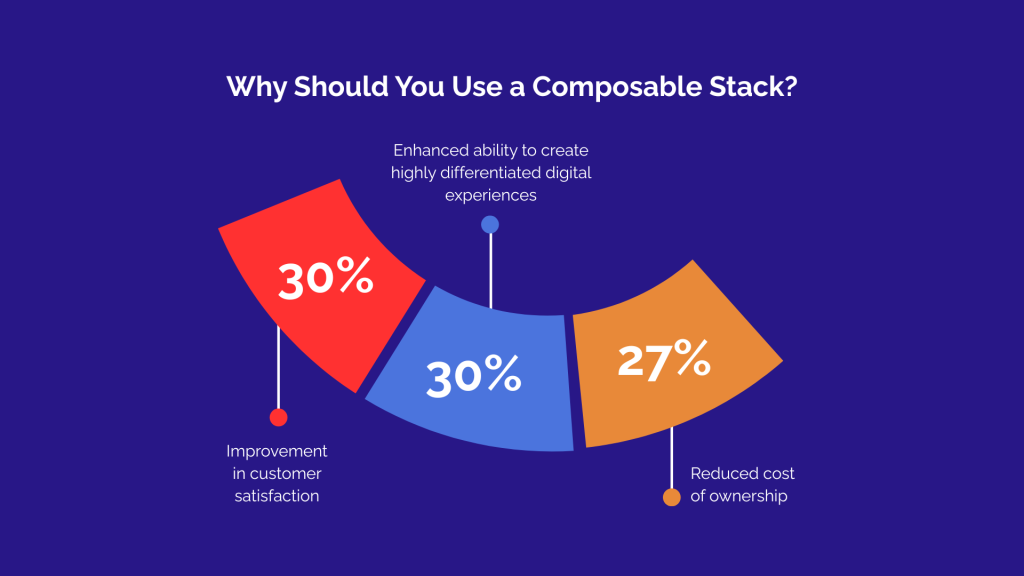
The top benefits of composable commerce:
- 30% Improvement in customer satisfaction
- 30% Enhanced ability to create highly differentiated digital experiences
- 27% Reduced cost of ownership
There are many reasons why more eCommerce brands are going composable. Here are some of the biggest benefits:
Flexibility
You’re not stuck with tools you don’t like. You can add or remove tools as needed. Want to switch to a better CRM? Go ahead. It won’t affect your CMS or product manager.
Faster Changes
With smaller tools, updates take less time. You don’t have to wait for a full system upgrade. You can try new ideas or features quickly.
Cost Control
You only pay for what you use. Traditional platforms often charge for features you may never touch. A composable stack lets you avoid waste and save money.
Easy Upgrades
When one tool needs an upgrade, you don’t need to stop everything. Just upgrade that one part. This makes your system stronger and more stable.
Better Performance
Each tool in a composable stack is best in its class. You choose tools that are known to perform well. This leads to faster websites, fewer errors, and happier customers.
According to Queue-it, 30% of executives said composable setups helped them create more personalized digital experiences. Another 27% reported cost savings, and 28% saw faster time-to-market.
This makes it an ideal model for scaling agile businesses and adapting to changing customer expectations.
How to Transition to Composable Commerce and Tech Stack

Adopting Composable Commerce is more than just a technological shift; it’s about reimagining your business strategy to embrace flexibility, scalability, and customization. Here’s a step-by-step guide to facilitate this transition:
Step 1. Assess Your Current Infrastructure
Begin by evaluating your existing eCommerce setup. Evaluate which parts of your current setup support growth—and which ones slow you down or limit flexibility. This assessment will help pinpoint areas that require transformation.
Step 2. Define Clear Business Objectives
Establish specific goals for the transition, such as improving customer experience, accelerating time-to-market, or enhancing scalability. Having well-defined goals helps steer every decision you make during the transition.
Step 3. Identify Suitable Modular Components
Research and select best-of-breed solutions for each business function—like CMS, PIM, CRM, and payment gateways—that align with your objectives. Ensure these components can integrate seamlessly through APIs.
Step 4. Develop a Phased Implementation Plan
Adopt a gradual approach to implementation. Start by integrating components that offer immediate value and pose minimal risk. This phased strategy allows for testing and adjustments without disrupting operations.
Step 5. Ensure Team Alignment and Training
Educate your team about the new architecture and workflows. Provide necessary training to ensure they can effectively manage and utilize the new system. Team alignment is crucial for a smooth transition.
Step 6. Monitor Performance and Iterate
After implementation, continuously monitor system performance and gather feedback. Use this data to make informed adjustments, ensuring the system evolves with your business needs.
Overcoming Composable Commerce Challenges with Confidence

Adopting a composable commerce approach can feel overwhelming, especially for B2B businesses. Here are some of the most common challenges and how they can be addressed:
- 69% of retail executives say that the implementation takes over six months.
→ With the right strategy and phased planning, businesses can reduce timelines by focusing on quick-win components first.
- 34% struggle to hire people with the right technical skills.
→ Partnering with experienced specialists or agencies can fill critical skill gaps and reduce hiring pressure.
- 32% report integration and connection between tools is time-consuming.
→ Using modern APIs and proven integration frameworks helps streamline connectivity across systems.
- 45% cite overall implementation as a major hurdle.
→ With a clear strategy, trusted vendors, and thoughtful change management, the transition becomes far more achievable.
With the right composable commerce expertise, these challenges become easier to overcome.
Need help navigating these challenges?
Wagento can help you launch faster, integrate smarter, and scale confidently—so you can embrace composable commerce without the growing pains.
Unsure If Composable Is Right for You?
Let’s weigh the pros and cons of composable commerce based on your current setup, goals, and growth plans.
Final Thoughts
The future of eCommerce is changing fast. Businesses need tools that help them move quickly and stay flexible. A composable tech stack makes this possible. Composable commerce is more than a trend—it’s a smarter, more resilient way to run an eCommerce business. It aligns with modern principles like microservices architecture, headless commerce, and API-first development, allowing you to scale with confidence.
Instead of using a single platform for everything, you build your own system—piece by piece. You choose the best tools for your business. You connect them in smart ways. And you improve your system as your business grows.
You don’t have to be a tech expert to go composable. You just need to understand your goals and pick tools that support them.
Start small. Solve real problems. Grow at your own pace.
Composable tech stacks give you more freedom, better performance, and the power to adapt.
It’s your store. Build it your way.
Frequently Asked Questions
Composable commerce is a modern approach to building eCommerce platforms using modular, best-of-breed components. Instead of relying on a single, monolithic system, you can “compose” your tech stack by selecting individual services—such as a CMS, PIM, or checkout engine—that are connected via APIs. This allows for greater flexibility, easier upgrades, and faster innovation across your eCommerce operations.
Composable technology refers to the practice of building digital systems using interchangeable and independent modules. In eCommerce, this often means selecting tools like headless CMS, ERP, CRM, and OMS, then connecting them through APIs to form a custom platform. The benefit of composable technology is that it enables you to scale and adapt quickly without being locked into a single vendor or system.
Composable architecture is the technical foundation of composable commerce. It follows an API-first, cloud-native, and microservices architecture model. This structure allows each system component (like search, pricing, or cart) to operate independently, making it easier to update, replace, or scale any part without affecting the others. Composable architecture is ideal for businesses that need agility and future-ready infrastructure.
Composable commerce is different because it shifts control back to the business. Traditional platforms are often monolithic, meaning all features are bundled together, which can slow down innovation and increase costs over time. In contrast, composable commerce allows businesses to choose only the tools they need, integrate them seamlessly, and adapt quickly as requirements evolve. This results in faster go-to-market, lower long-term costs, and a more tailored customer experience.
Headless commerce is an eCommerce architecture where the front-end (the “head”) is decoupled from the back-end systems. This means your storefront or user interface can be built using any framework or technology, while still communicating with back-end tools like your CMS, product database, or cart system via APIs. Headless commerce supports greater design flexibility, faster content delivery, and the ability to create consistent experiences across web, mobile, and other digital touchpoints.
Headless commerce works by allowing the front end and back end of your site to operate independently but stay connected through APIs. In a composable architecture, this headless structure is one of the key components—it enables businesses to swap or update the UI, checkout experience, or content engine without touching the core commerce engine. This leads to faster updates, better performance, and more freedom to create customized digital experiences for each channel or user group.