


















Before You Make the Leap: A Story that May Sound Familiar
A mid-sized manufacturer had just completed a costly platform migration from Magento to Shopify Plus. They hoped for smoother operations, faster speed, and better conversion rates. Six months in, nothing really changed—except the invoices.
When they brought the right agency in for a project rescue audit, the problem wasn’t the platform. It was the agency they had hired. Poorly configured backend logic, amateur integration of ERP systems, and no CRO strategy meant the migration was a band-aid, not a solution.
Before you blame the platform, scrutinize your eCommerce agency.
B2B vs. B2C: The Role of an eCommerce Agency Today
An eCommerce agency is more than just a team that builds your site—it’s your strategic partner in digital growth. But the expectations from an agency differ significantly in B2B and B2C industries. Here’s how:
| Function | B2C eCommerce Agency Role | B2B eCommerce Agency Role |
| Customer Experience | Focuses on visual design, UX, mobile-first approach | Prioritizes account-based personalization, buyer roles, and workflows |
| Integrations | Integrates marketing tools, payment gateways, analytics | Integrates ERPs, CRMs, PIMs, CPQs, and procurement systems |
| Sales Process | Straightforward, direct-to-customer funnel | Multi-stage, quote-based, and volume-discount pricing models |
| Scalability Needs | Handles flash sales and peak seasons | Supports long-term growth, dealer portals, multi-store environments |
| Product Complexity | Simple SKUs, lifestyle products | Configurable products, bulk ordering, pricing tiers |
In both cases, the right agency can be the difference between digital chaos and a well-oiled revenue machine.
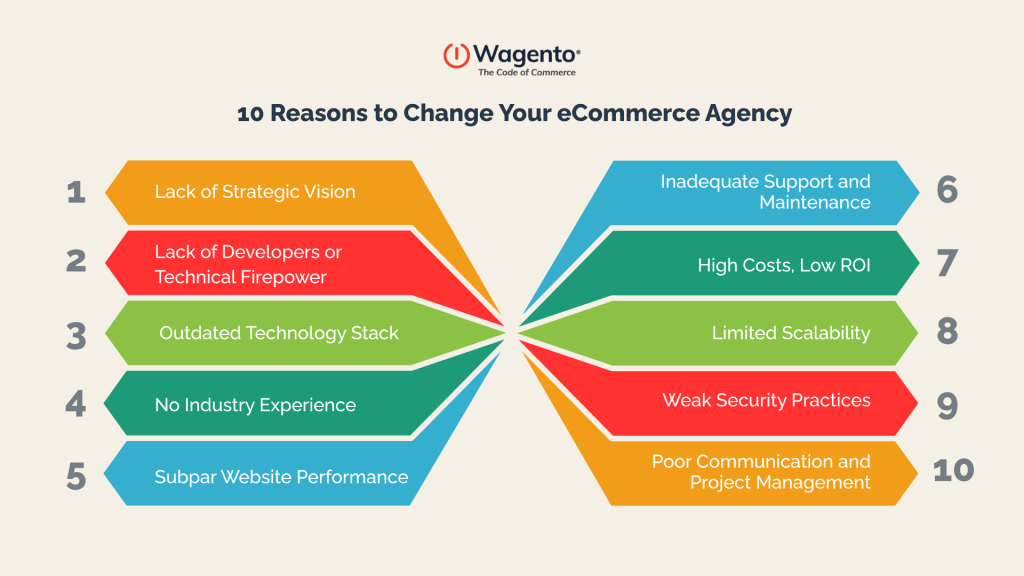
10 Signs It’s Time to Switch Your eCommerce Agency
1. Lack of Strategic Vision
A reliable agency does more than just execute deliverables—they contribute to your long-term business success. If your agency isn’t proactively advising on:
- Conversion Rate Optimization (CRO) tactics (e.g., A/B testing, funnel analysis),
- Omnichannel strategies (e.g., integrating in-store, mobile, and online),
- or Personalization techniques (like segment-specific promotions or AI-based recommendations),
then you’re missing out on significant growth opportunities. Agencies should act as strategic partners, bringing fresh ideas, consumer behavior insights, and data-driven roadmaps—not just waiting for your next task list.
Ask yourself: Is my agency guiding us toward future-ready growth, or just ticking boxes?
2. Lack of Developers or Technical Firepower
As your business grows, so does the technical complexity. Whether you’re on Adobe Commerce, BigCommerce, Scayle, Shopify Plus, or even legacy Magento:
- Can your agency handle complex integrations with ERP, CRM, or PIM systems?
- Do they support headless builds, custom apps, or GraphQL APIs?
- Are they comfortable working with international storefronts, progressive web apps (PWAs), or composable architecture?
If your current agency struggles to meet technical demands or relies heavily on plugins with no ability to customize, your business performance—and scalability—is at risk.
3. Outdated Technology Stack
Sticking with outdated technology isn’t just inconvenient—it’s dangerous.
If your agency is:
- Building sites using outdated templates or unsupported plugins,
- Avoiding AI-driven solutions for product recommendations, search, or customer segmentation,
- Or ignoring modern tools like serverless deployment, API-first infrastructure, or headless commerce,
then you’re being left behind in a fast-evolving eCommerce landscape. The right agency ensures you’re future-proofed with scalable, flexible, and competitive solutions.
4. No Industry Experience
An agency unfamiliar with your sector is a liability, not an asset.
For instance:
- A healthcare supplier might require HIPAA compliance or gated content.
- A manufacturer may need quote management, dealer portals, and complex pricing rules.
- An automotive parts distributor might need advanced product filters, fitment tools, and bulk order flows.
Agencies that lack domain knowledge often deliver generic solutions—leading to poor user experiences, missed sales opportunities, and technical misfits.
Look for a partner who “gets” your audience and operational complexity.
5. Subpar Website Performance
In today’s digital market, speed = sales. A sluggish site leads to:
- Increased bounce rates
- Lower search engine rankings (due to poor Core Web Vitals)
- Frustrated users, especially on mobile
Signs of performance neglect include:
- Pages taking over 2.5 seconds to load
- Low Lighthouse or GTmetrix scores
- Poor mobile responsiveness
A competent agency treats performance as a non-negotiable, using lazy loading, image compression, CDNs, caching, and proper code structure to deliver smooth, fast experiences.
6. Inadequate Support and Maintenance
eCommerce is a 24/7 business. Downtime = lost revenue.
If your current agency:
- Takes days to respond to bug reports,
- Has no clear Service Level Agreement (SLA) post-launch,
- Or doesn’t offer proactive maintenance (security patches, updates, audits),
then you’re one bug away from chaos. A good agency acts as an extended part of your team, available when you need them most.
7. High Costs, Low ROI
You’re likely paying tens of thousands annually to your agency. But are you seeing:
- Increased conversions?
- Lower cart abandonment?
- Higher average order value?
If not, your investment isn’t yielding returns. Worse, some agencies:
- Use bloated retainer models without clear output
- Charge for rework due to initial mismanagement
- Reuse templates instead of delivering tailored solutions
A top-tier agency is focused on outcomes, not just outputs—and every dollar spent should push you toward your KPIs.
Not Sure Whether to Replatform or Replace Your Agency?
Let’s help you evaluate both paths—whether it’s time for a new platform or just the right partner to bring your current one to life.
8. Limited Scalability
Your business won’t look the same in 2 years—does your agency plan for that?
If your current partner can’t:
- Support multi-storefront builds for different regions or brands,
- Handle large catalogs or SKU variations,
- Build infrastructure that scales with traffic or order volume,
- Or integrate seamlessly with new tools as you grow,
then you’re likely to hit a ceiling. A growth-oriented agency builds with scalability in mind from day one.
9. Weak Security Practices
Security is not optional—it’s foundational.
If your agency:
- Ignores PCI DSS or GDPR standards,
- Leaves admin panels exposed,
- Doesn’t use HTTPS, tokenization, or secure coding practices,
you’re exposed to breaches, lawsuits, and loss of trust. In regulated industries like finance, healthcare, or government, this could be catastrophic.
Your agency should be performing:
- Regular security audits
- Penetration testing
- Update management (e.g., Magento patching or plugin vulnerability checks)
Security should be built into every step, not treated as an afterthought.
10. Poor Communication and Project Management
Great code means little without strong communication.
If your agency:
- Sends infrequent or unclear updates
- Doesn’t use modern project management tools (like Jira, Trello, or Asana)
- Leaves you wondering what’s happening with your project
—you’re wasting time and money. A good agency runs structured sprints, sets transparent timelines, and makes you feel heard.
You should never feel like you’re managing your agency. They should be managing your success.
Need a checklist to decide? Here it is:
5 Questions to Ask Before Hiring Your Next eCommerce Agency
Hiring an eCommerce agency isn’t just about technical skills—it’s about choosing a long-term growth partner who understands your industry, your goals, and your customers. Here are five critical questions to ask that go beyond the surface and help you filter out task-driven vendors from strategic collaborators.
1. What’s your experience with businesses in my industry?
Not all eCommerce industries are created equal. Selling direct-to-consumer T-shirts is vastly different from managing a B2B industrial supply chain with ERP integrations and multi-tier pricing. When evaluating an agency, ask them:
- Do you have experience working with businesses in my niche—manufacturing, healthcare, automotive, education, etc.?
- Can you share case studies or examples relevant to my business model (DTC, B2B, B2B2C, etc.)?
- Have you faced and solved the kinds of challenges we’re currently dealing with—like quote workflows, gated content, or compliance-heavy checkouts?
Why it matters: Industry experience shortens the learning curve, reduces risk, and ensures you won’t be a test project.
2. How do you approach post-launch support and performance monitoring?
Launching the site is just one part of the journey. Many businesses suffer when agencies treat go-live as the end rather than the beginning of a support lifecycle.
Ask:
- What’s your post-launch support structure? Do you offer SLA-based maintenance plans?
- How often do you perform health audits or monitor performance metrics (Core Web Vitals, uptime, SEO)?
- Do you provide a dedicated support team, or is it ticket-based?
Why it matters: A site that breaks during a product drop or lags during peak season can cost thousands in lost revenue. Proactive support prevents these issues and builds confidence.
3. How will you align with our long-term business goals?
A competent agency does more than deliver features—they understand your growth roadmap and work backward from there.
Ask them:
- How do you incorporate our KPIs (conversion rate, CAC, AOV, CLTV) into your strategy?
- Do you offer consulting on CRO, omnichannel selling, or market expansion?
- How often do we meet to revisit and realign strategy?
Why it matters: You don’t want a partner who just builds what you ask for. You want one who challenges your assumptions, brings better solutions, and scales with you.
4. What’s your process for integrations and automation?
Integration is the backbone of a scalable eCommerce operation. From inventory sync to CRM workflows, a modern store cannot operate in isolation.
Ask:
- What’s your approach to integrating platforms like ERP (e.g., NetSuite, Epicor), CRM (e.g., Salesforce), PIM (e.g., Sales Layer), or shipping/payment providers?
- Do you build custom APIs, use middleware (like iPaaS), or depend on plugins?
- Can you automate workflows like abandoned cart recovery, back-in-stock alerts, or tiered discount rules?
Why it matters: Poor integration leads to broken experiences, inaccurate data, and operational bottlenecks. An agency that understands automation reduces manual work and improves efficiency.
5. Can I speak with your developers or project managers before we start?
The biggest issues in agency relationships often boil down to communication and alignment. Speaking directly to the people who’ll execute your vision helps you assess their clarity, transparency, and expertise.
Ask:
- Can I meet the tech lead or project manager before onboarding?
- Will I have access to your team during the project, or do all messages funnel through an account manager?
- How do you handle project tracking and communication (Slack, Jira, Asana, weekly calls)?
Why it matters: Access to your delivery team builds trust. You want a transparent, collaborative, and accountable agency—not a black box.
Interested in Seeing the Before-and-After Results?
Read real-life stories of how changing an agency helped brands that are now roaring high.
5 Background Checks Before You Finalize an eCommerce Agency
- Portfolio Audit:
Don’t just look at their website. Ask for live sites they’ve built and measure performance, UX, and functionality.
- Team Structure:
Do they have in-house certified developers? Or do they outsource?
- Client Testimonials:
Look beyond cherry-picked quotes. Check Clutch, Google Reviews, or speak with references.
- Process Maturity:
Ask about project planning, sprint reviews, QA, and documentation. A mature agency has clear frameworks.
- Security and Compliance Record:
Ask how they handle customer data, secure coding, and compliance regulations like GDPR or ADA.
Real-World Turnarounds: Project Rescue Case Studies
When businesses outgrow their agencies, they come to us.
Many of our most successful projects began with frustrated clients—those stuck with underperforming websites, clunky integrations, or unresponsive partners. Here’s how Wagento stepped in to turn things around:
Case Study 1: Kimber America – From Unfinished Project to 50% Less Customer Service Load
Problem: Magento RMA integration was left incomplete by a previous agency, causing customer frustration and internal support overload.
Old Agency Mistake: Project delays, lack of technical clarity, no resolution roadmap.
Wagento’s Fix: Took over midstream, completed the RMA integration, optimized customer workflows, and implemented backend tools to support the CS team.
Result:
✅ Customer service team workload reduced by 50%
✅ Improved returns processing and customer satisfaction
Case Study 2: Rifles Only – Saved from a Failing Platform and Poor Support
Problem: The firearms brand was stuck on a slow, unsupported platform with unresponsive agency support.
Old Agency Mistake: Poor implementation, bad customer service, no growth support.
Wagento’s Fix: Full migration to BigCommerce, improved backend performance, enhanced product catalog and checkout experience.
Result:
✅ 30% increase in sales efficiency
✅ Higher customer satisfaction and platform stability
Case Study 3: Island Beach Gear – From Performance Frustration to a 90+ Score
Problem: Their Magento site under a different agency was slow, hard to manage, and not mobile-friendly.
Old Agency Mistake: Bloated architecture, poor code quality, lack of mobile responsiveness.
Wagento’s Fix: Migrated to BigCommerce, redesigned the storefront, optimized speed, and implemented cost-efficient tech.
Result:
✅ Performance score improved from 40 to 90+
✅ Reduced total cost of ownership and 2x faster load times
The Right Agency Also Knows the Right Stack
At Wagento, we believe great results come from the perfect mix of strategy, execution, and the right tools. Over the years, we’ve built strong relationships with leading technology providers to deliver scalable, high-performance solutions tailored to your goals—not just to your tech stack.
Over the years, we’ve partnered with some of the most respected names in the eCommerce ecosystem—Adobe Commerce, BigCommerce, Shopify Plus, WooCommerce, and Scayle—to help businesses scale with confidence. For seamless integration and specialized capabilities, we work with leading tech partners including Sales Layer (PIM), DCKAP (ERP connectors), Hyvä (performance-optimized frontends), Sift (fraud protection), iPaaS.com (integration automation), Klevu (AI-powered search), ShipperHQ, Klaviyo, Webscale, and many more.
The difference isn’t just in the platform—it’s in the people and partners who bring it to life.
Final Thoughts: Rebuild with Purpose, Not Panic
Switching platforms can be a huge investment. But many “platform issues” are actually agency issues in disguise. Before committing to a costly rebuild, ask yourself: is it really the platform—or is it the people building it?
If your agency can’t keep up with your growth, doesn’t understand your industry, or leaves you in the dark—you deserve better. Your success depends on an expert partner that knows how to make your tech stack work for you, not against you.
Get Help from the Right Agency
Partner with experts who love to listen and understand your business and drive results that matter. Let’s unlock your full potential together!
Helpful Resources You Want to Save:
FAQs
Changing your eCommerce agency might be necessary if you’re not seeing the results you expect. If your current agency is not offering strategic advice, isn’t responsive to your needs, or is failing to implement the latest technology, it could be hindering your growth. Additionally, if you notice performance issues, slow site speed, or poor customer experiences, it might be time to make the change. A new agency could bring fresh perspectives, advanced tools, and better support to help your business thrive.
An eCommerce agency can optimize your platform by implementing modern technologies, improving the user experience, and ensuring fast load times. They focus on enhancing performance metrics like Core Web Vitals, which directly impact your SEO and user retention. Through advanced features such as headless commerce, APIs, and serverless deployments, an agency can help ensure your platform is scalable, secure, and delivers a seamless experience for your customers, which ultimately boosts conversions and overall site performance.
While replatforming can seem like an easy solution to improving your eCommerce performance, it’s not always the right choice. If the issue lies with your agency’s execution rather than the platform itself, simply changing platforms won’t solve the underlying problems. Replatforming can be costly and time-consuming, and it might not address the root causes such as poor integration, lack of strategy, or outdated technology. In many cases, switching to a new, more capable agency can optimize your existing platform and ensure it performs better without the need for an expensive and disruptive platform change.
Choosing an experienced eCommerce agency ensures that you’re working with experts who understand the technical and strategic needs of your business. An experienced agency can help with everything from platform migration to integrating third-party systems. They bring knowledge of the latest trends and technologies, ensuring your platform is optimized for both short-term success and long-term scalability. Working with professionals who understand your industry and business model can lead to better solutions and faster growth.
To determine if you’re choosing the right eCommerce agency, evaluate their expertise in your specific industry and business model. Ensure they have a proven track record of delivering successful projects similar to yours, whether in B2B or B2C. Check their understanding of your goals, their approach to problem-solving, and their ability to implement modern technologies that align with your long-term vision. Additionally, consider their communication, support, and transparency throughout the selection process. A good agency should feel like a strategic partner, not just a service provider, and should be able to guide you toward measurable results.
Here are the key indications that it’s time to change your eCommerce agency. If you tick more than 3 items, it’s time to consider making the switch.
Lack of Strategic Guidance
Poor Performance Metrics
Inconsistent Communication
Missed Deadlines
Lack of Technical Expertise
High Costs, Low ROI
No Focus on Optimization
Limited Support and Maintenance