



The 2025 LinkedIn Landscape — What’s Changed & What Matters
Algorithm shifts you must understand
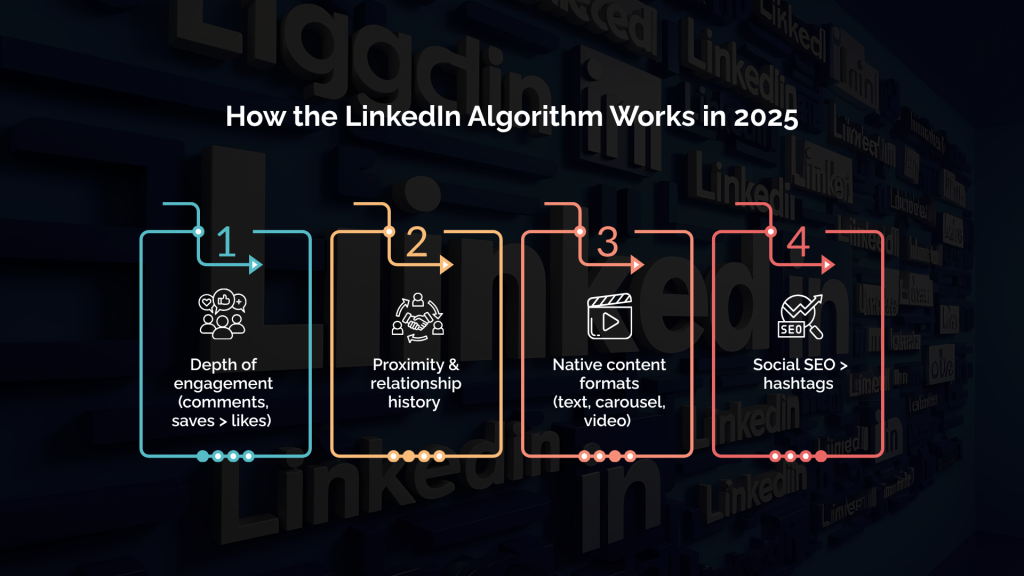
In 2025, LinkedIn’s algorithm has evolved to favor depth over volume. It now prioritizes content that sparks real engagement (thoughtful comments, multi-comment threads, saves, dwell time) rather than just quick reactions or surface likes.
Also, user intent and relational proximity play bigger roles: posts from people you’ve already engaged with are more likely to be shown to you.
LinkedIn is also rewarding subject-matter expertise: posts that provide original insights, technical depth, case studies, or perspectives from practitioners are more boosted than generic “10 tips” content.
Moreover, the algorithm is favoring native content formats (text + image, carousels, short-form video) over offsite links.
Finally, LinkedIn is de-emphasizing hashtag reach and instead leaning into Social SEO: the use of relevant keywords in the text, title, and profile to help content be discoverable.
Implication for B2B marketers: You can’t treat LinkedIn like a broadcast channel anymore. It’s more like a conversation engine. To win, you must integrate relevance, depth, and relationship history into your content strategy.
Why B2B still leans on LinkedIn (and what’s at stake)
- LinkedIn continues to dominate the B2B social space: many surveys show that a large majority of B2B marketers find it the most valuable social channel.
- In 2025, video + creator content are making a strong push. The 2025 B2B Marketing Benchmark shows video and creator influence as top differentiators for trust-building.
- LinkedIn is also rolling out new ad formats to help marketers — like First-Impression Ads and reserved slots to capture attention early.
- Organic reach is harder, but smart hybrid strategies (organic + paid) still win.
So: the stakes are higher. If your competitors adapt and you don’t, your content disappears.
Foundational Moves
Optimizing your LinkedIn Profile for B2B marketing
Your profile is not just a resume; it’s a conversion asset. A well-optimized profile helps with content distribution, credibility, search, and outreach success.
Key elements to refine:
- Headline & tagline: not just your role, include your niche + value proposition. Use keywords your ideal clients search for.
- About section / summary: tell your “why,” show outcomes, and position your expertise. Use subheadings, bullet lists, and even short stories.
- Featured section & media: include best posts, case studies, whitepapers, or client wins.
- Experience / Projects: don’t just list duties, show measurable results and outcomes.
- Skills & endorsements: pick 3–5 key skills for your niche and invite relevant peers to endorse them.
- Publisher / Creator mode / Newsletter: turning on creator mode can help give priority to your posts and increase visibility for your content.
- Contact / links / website: make sure your calls to action are clear (book a call, download a lead magnet, link to a case study).
According to sources, a fully optimized profile now plays a major role in how LinkedIn’s algorithm boosts your reach and how outreach efforts perform.
Niche positioning & content theme clarity
Before you publish, be crystal clear on:
- Your ideal client persona (ICP) and what challenges they care about.
- 3–5 content pillars (topics) you want to own (e.g. automation, scaling B2B, case studies, leadership in your vertical).
- Your voice / point of view: you don’t need to be neutral. Take a stance, critique common beliefs, and experiment — that will help generate conversation.
Many blogs in 2025 stress the importance of breaking away from generic content and focusing on expert positioning.
Content Strategy & Publishing Tactics
Format mix — what to publish (and how often)
In 2025, a smart mix of formats helps you balance reach, depth, and engagement:
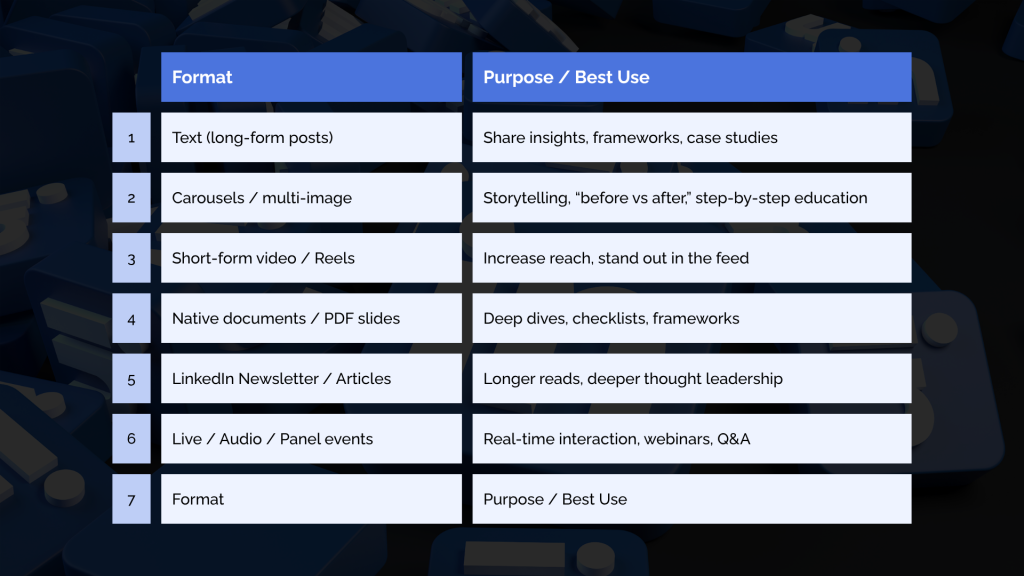
| Format | Purpose / Best Use | Tips |
| Text (long-form posts) | Share insights, frameworks, case studies | Use strong hook (question, bold claim), break into short paragraphs |
| Carousels / multi-image | Storytelling, “before vs after,” step-by-step education | Use consistent branding and sequenced narratives |
| Short-form video / Reels | Increase reach, stand out in the feed | 30–60 seconds, mobile-first, include subtitles |
| Native documents / PDF slides | Deep dives, checklists, frameworks | People can save/share, which signals algorithm value |
| LinkedIn Newsletter / Articles | Longer reads, deeper thought leadership | Use to build a repeat audience & subscriber base |
| Live / Audio / Panel events | Real-time interaction, webinars, Q&A | Promote ahead, bring in co-hosts, reuse snippets later |
The 2025 B2B Marketing Benchmark signals that video + creator content are becoming disproportionately powerful in trust building.
Hootsuite and Sprout Social analysis also confirm that encouraging conversations (asking questions, prompting reply) tends to outperform passive posts in the 2025 algorithm.
Publishing cadence recommendations:
- Core content (text / carousel / video): 2–4 per week
- Engagement posts (questions, polls, comment prompts): 2–3 per week
- Newsletter / long-form: 1–2 per month
- Live / event content: 1 per quarter (plus snippets repurposed)
CTA within posts: Always end with a prompt — “Which part of this applies to you? Let me know in the comments.” “DM me your biggest pain point.” “Download the checklist here.”
To scale high-quality posts without burning out, apply these AI ideas for smarter B2B content to your LinkedIn workflow.
Social SEO & keyword integration
Because hashtags are losing prominence, you must lean into Social SEO:
- Use relevant keywords (niche problems, roles, solutions) naturally in the first 2 lines, in subheads, and in the closing of your posts.
- Optimize your profile (headline, about section) with the same keywords to increase discoverability.
- Use phrases that your audience might search for (e.g. “B2B LinkedIn lead generation,” “optimize LinkedIn profile for SaaS”)
- Don’t overstuff. Readability and natural flow still matter.
Engagement tactics that fuel the algorithm
To ride algorithm momentum, you need to orchestrate engagement after posting:
- First 30 minutes matter: reply to comments quickly (within 10–20 min). Encourage back-and-forth.
- Comment chains over likes: prompt people to add their take, disagree, or build on.
- Respond to replies with questions to deepen the conversation (e.g. “That’s a sharp point — in your experience, how would you tweak it?”)
- Tag relevant people / ask them to weigh in — but do so selectively (don’t feel like spam).
- Use “save” prompts (e.g. “Save this post to revisit later”) to boost dwell metrics.
- Repurpose / resurface good content (reshare with new angle or post a “Part 2”) to give older content fresh life.
Lead Generation, Outreach & Sales via LinkedIn
Building your lead generation funnel
Think of your LinkedIn activity as a mini funnel:
- Awareness: content attracts your target.
- Engagement: comments, DMs, conversations.
- Lead capture: gated content, webinars, forms, chat.
- Sales handoff: hand leads to sales or process qualification.
Best practices:
- Use LinkedIn Lead Gen Forms in ads or content campaigns (they are native and reduce friction).
- Host webinars or live sessions and gate registration.
- Use content upgrades (checklists, templates) as opt-ins.
- Follow up fast: leads from LinkedIn tend to cool quickly if not engaged promptly.
If you want to test hooks, offers, and CTAs systematically, borrow these growth marketing tactics to run rapid experiments and lift LinkedIn-to-pipeline conversion.
Connection and outreach strategies that convert
You can’t cold-message in bulk. The 2025 audience expects context, relevance, and proof:
Stepwise outreach approach:
- Warm engagement: First, engage with a prospect’s content (comment meaningfully).
- Connection request with context: “Hi [Name], I saw your comment on [topic] and I’m curious about your take on [related challenge]. Would love to connect.”
- Immediate value message (1–2 days later): one micro insight or resource (not a pitch).
- Second message (if no response): ask a question (“Do you struggle with X?”) or invite them to a short call.
- Third message: show a mini case or client outcome, ask if they’d like to explore further.
Avoid generic templates. Personalize based on profile signals (company, role, recent posts) and pain points.
Also consider Account-Based Marketing (ABM)—use LinkedIn to treat specific high-value accounts as a mini campaign: content, ads, messaging, events all aligned to the account.
Nurturing & qualification within LinkedIn
- Use LinkedIn Stories / Reels to drop micro content and human moments (behind the scenes, client wins).
- Use polls to surface pain points and crowdsource which topics your audience cares about.
- Save and tag engaged profiles (e.g. with a CRM integration) for follow-up.
- Use LinkedIn Messaging + Notes to track where each prospect is in your funnel.
- When engagement reaches the threshold (e.g. repeated comments, content interaction), move to a soft call or discovery session.
Measuring What Matters
Key metrics & KPIs for B2B LinkedIn
- Reach / Impressions (initial benchmark)
- Engagement rate (comments + replies + saves / impressions)
- Clicks / CTR (for gated offers)
- Leads generated via forms, chat, or webinar sign-ups
- Conversion rate to SQL / MQL
- Follower growth (targeted, relevant followers)
- Sentiment / qualitative feedback (theme analysis of comments)
Because LinkedIn is driving for “meaningful engagement,” don’t overfocus on vanity metrics (likes, followers). A post with 100 comments and 5,000 reach is often more valuable than one with 5,000 likes and 500 comments.
Combine LinkedIn analytics with your CRM to track how content leads eventually convert to deals.
Content Ideas & Angles That Work in 2025
Here are tested content concepts to drive engagement, relevance, and leads:
- Case study breakdowns (before / after, metrics, playbooks)
- Failure post: what went wrong + what you’d do differently
- Step-by-step framework / templates (e.g. “5-step outreach”)
- Trend commentary: react to new algorithm, industry shifts
- “Thread” style posts: multi-part, bite-sized numbered tips
- Hot takes / contrarian views (with evidence)
- Ask-me-anything (AMA) posts: “What’s your biggest B2B LinkedIn pain?”
- Micro storytelling: client story in 3–4 sentences with a lesson
- Polls + follow-up post: poll a question, then next day share insights
- Swipe files / resources: share what you use internally
- “Two truths & a lie” about B2B LinkedIn myths
- Co-posts / guest takeovers: invite someone to share a post from their angle
Make a content calendar that interleaves “engagement-first posts” with deeper value content + lead magnets.
Scaling, Team + Advocacy
Employee advocacy & content amplification
Your employees (especially sales, customer success, ops) have valuable networks. Activate them:
- Provide post templates or draft content they can personalize
- Encourage employees to share / comment / amplify your core posts
- Recognize top contributors internally (leaderboard, incentives)
- Train them on tone, comment etiquette, proper tagging
Since employee profiles often have more relational equity, their shares can boost reach more than your brand page.
Content delegation & workflow
- Use a content brief system (topic, angle, keywords, CTA)
- Maintain a content bank (evergreen ideas)
- Build a mini content approval flow (review, edit, schedule)
- Use tools that integrate with LinkedIn (e.g. social schedulers, analytics)
- Track post performance weekly and flag highs + lows for review
As your team grows, you can shift from “solo creator” to “content factory” with a small editorial backbone.
Feeling overwhelmed by all these changes?
We’ll audit your profile, content, and funnel and deliver a 30-point action plan.
2025 Trends & Future Signals to Watch
- Video + short-form content will keep dominating — LinkedIn is doubling down on creators and video ad opportunities. Reuters
- AI-driven content personalization — hyper-targeted content, micro-experiences on LinkedIn for individual prospects
- More integration with Microsoft stack (Teams, Outlook, Office) → more seamless reach and content sharing
- Graph neural networks powering notifications & reach (LinkedIn is investing in advanced AI systems) arXiv
- Multimodal ad formats — combining video, dynamic creative, and interactive documents
- Conversational marketing within LinkedIn (chat bots, embedded flows)
- Increased focus on retention / nurture via LinkedIn, not just acquisition
Stay curious, experiment monthly, and double down on what works.
For broader context on the forces shaping your buyers, review these B2B eCommerce strategies and align your LinkedIn plan accordingly.”
FAQs
How often should I post on LinkedIn in 2025?
Aim for 2–4 core posts per week (text, carousels, or video) + 2–3 engagement prompts (polls, questions). You can do a long-form / newsletter once or twice a month. Consistency matters more than volume.
Should I bother with hashtags?
Hashtags still have limited use, but they are less effective now. Use 2–3 highly relevant hashtags. Focus more on including niche keywords in your content (Social SEO).
What’s the ideal length for a LinkedIn post?
For text posts, aim for 150–300 words (enough depth to provide value). For carousels, 5–10 slides. Videos: 30–60 seconds. Use readability techniques (short lines, spaces).
How do I avoid being too salesy?
Use the 80/20 rule: 80% value, 20% promotional. In outreach, lead with insight, not a pitch. Use soft CTAs (“Would you like to see a case study?”).
How long does it take to see results?
You should see improved reach and engagement in 4–6 weeks if you’re consistent. Lead generation may take 2–3 months as relationships build. Don’t rely on a single post — treat it as a compounding system.
Final Thoughts
In 2025, LinkedIn is no longer just a networking site; it’s a content + conversion ecosystem. The algorithm is smarter, the audience more discerning, and the opportunities for those who adapt, more powerful.
If you optimize your profile, publish with intention, and convert through relationship-based outreach, LinkedIn can become your most dependable B2B lead engine.
Let us know when you’d like help turning this into a conversion funnel or social campaign. We’re ready when you are.