




Introducing Wagento TCO Assurance
A growing commerce business sits down for its annual planning meeting.
Marketing is focused on conversion rates and speed.
Technology is thinking about integrations and scalability.
Operations is concerned about manual work and process bottlenecks.
Finance is looking at a single question: “Why does our eCommerce cost keep rising when our platform fees haven’t changed?”
Everyone has data. No one has the full picture.
Subscription costs look predictable. Infrastructure seems manageable. Yet app fees, integration expenses, support effort, and internal labor quietly add up year after year. What started as a “cost-effective” platform decision now feels difficult to explain in a spreadsheet.
This is the moment when teams realize they don’t have a platform problem — they have a visibility problem.
And that’s where a true TCO conversation begins.
The True TCO Advantage
Total Cost of Ownership (TCO) is one of the most misunderstood concepts in eCommerce platform selection.
Most platform comparisons focus on monthly fees, launch speed, or surface-level feature lists. Very few explain how cost actually accumulates over five years, once integrations, workflows, growth, and operational complexity are factored in.
That gap is exactly why we introduced Wagento TCO Assurance: a transparent, CFO-ready framework designed to help businesses understand, quantify, and plan for long-term platform ownership costs, regardless of the platform they choose.
This blog explains the methodology behind Wagento TCO Assurance, not to promote one platform over another, but to help decision-makers evaluate platforms using financial reality instead of assumptions.
Why Platform Costs Are Often Misunderstood
Many modern eCommerce platforms are positioned around qualities like:
- Simplicity
- Predictable pricing
- Fast time to market
- App-based extensibility
- Reduced upfront complexity
These attributes are genuinely valuable, especially in early growth stages. The challenge is that none of them, on their own, explain long-term ownership cost.
TCO is not about how a platform starts.
It is about how a platform behaves as the business evolves.
That evolution introduces new variables:
- Integrations
- Custom workflows
- Operational scale
- Team efficiency
- Infrastructure demands
Without a structured way to measure these variables, platform costs are often underestimated or misunderstood.
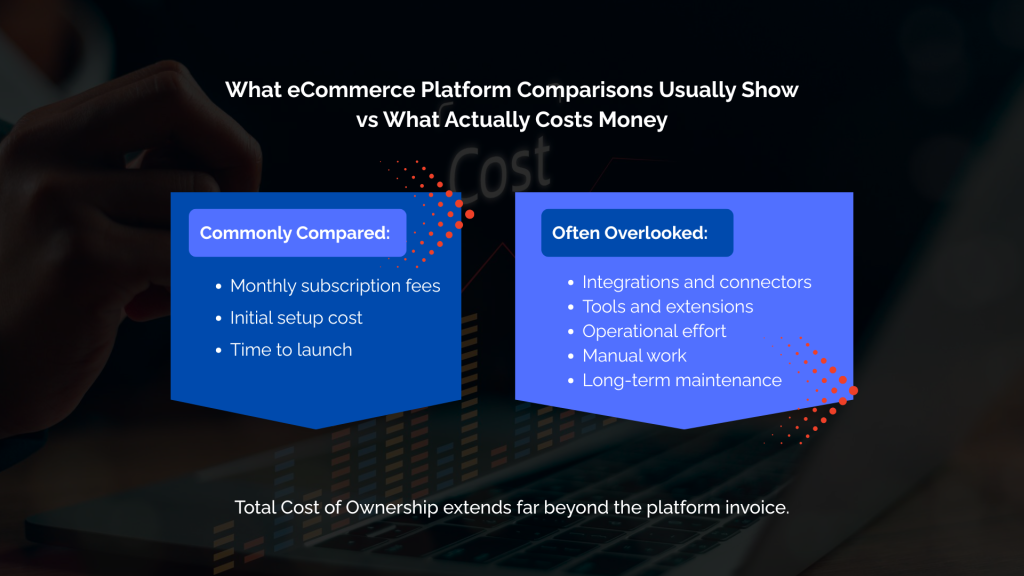
Predictability vs Total Cost of Ownership
One of the most common misconceptions in platform evaluation is equating predictable pricing with lower cost.
Predictability refers to:
- How bills are structured
- How consistent charges appear month to month
TCO, however, measures:
- What the business actually spends over time
- How costs grow as complexity increases
- Where operational inefficiencies emerge
A platform with predictable fees may still generate higher long-term cost if:
- Additional tools are required to support growth
- Manual processes increase as complexity rises
- Integrations require ongoing maintenance
- Workarounds become permanent
Wagento TCO Assurance exists to separate pricing perception from financial reality.

The Role of Ecosystems, Extensions, and Integrations
Modern eCommerce platforms rely heavily on ecosystems — apps, extensions, middleware, and third-party services. This is not inherently good or bad. It is simply a cost variable.
As businesses scale, these ecosystems often expand to support:
- ERP connectivity
- Inventory and warehouse logic
- Pricing and contract rules
- Multi-region operations
- B2B workflows
- Reporting and automation
Each added component introduces:
- Subscription or usage fees
- Maintenance overhead
- Dependency risk
- Operational complexity
TCO Assurance does not judge ecosystem models.
It quantifies their financial impact over time.
The Hidden Cost of Manual Operations
Another frequently overlooked element of TCO is labor efficiency.
Manual work rarely appears on platform comparison charts, yet it directly affects:
- Payroll cost
- Operational speed
- Error rates
- Team burnout
- Scalability
If teams spend hours each week manually adjusting catalogs, pricing, orders, or data flows, those hours represent real financial cost, regardless of platform subscription pricing.
Wagento TCO Assurance treats labor as a core cost driver, not an afterthought.
Introducing Wagento TCO Assurance
Wagento TCO Assurance is a platform-agnostic, structured framework for evaluating long-term eCommerce ownership cost.
It is designed for:
- CFOs and finance leaders
- CTOs and technical decision-makers
- Operations and growth teams
- Platform evaluation committees
The framework provides clarity, consistency, and transparency across different platform models.
What Is Wagento TCO Assurance?
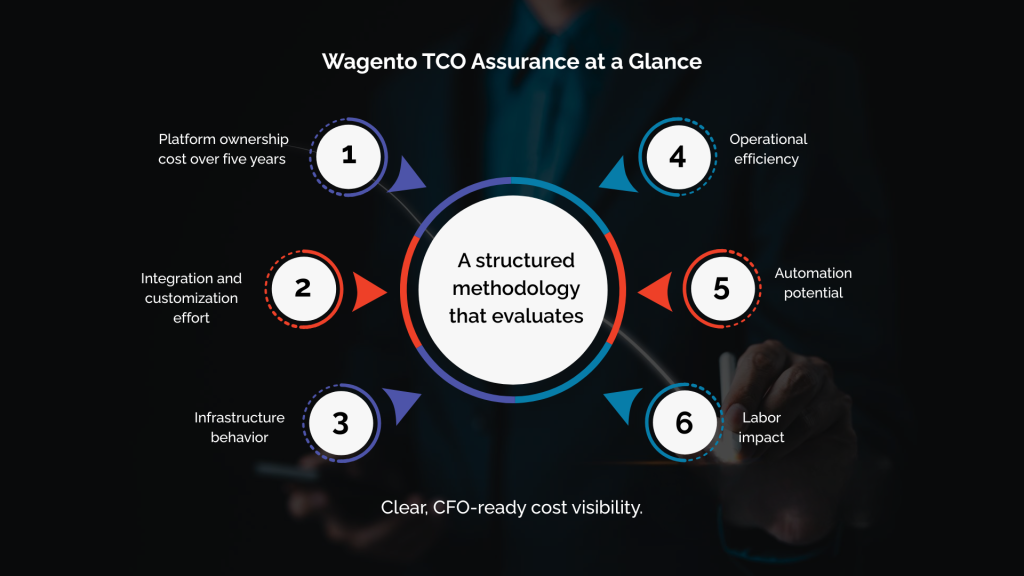
Wagento TCO Assurance is a quantified, repeatable, evidence-based methodology that evaluates:
- 5-year platform ownership cost
- Integration and customization effort
- Hosting and infrastructure behavior
- Operational efficiency
- Tool and ecosystem dependency
- Automation potential
- Labor impact
Rather than asking “Which platform is cheaper?”, it answers a more useful question:
“What will this platform truly cost our business as we grow?”
The Four Pillars of Wagento TCO Assurance
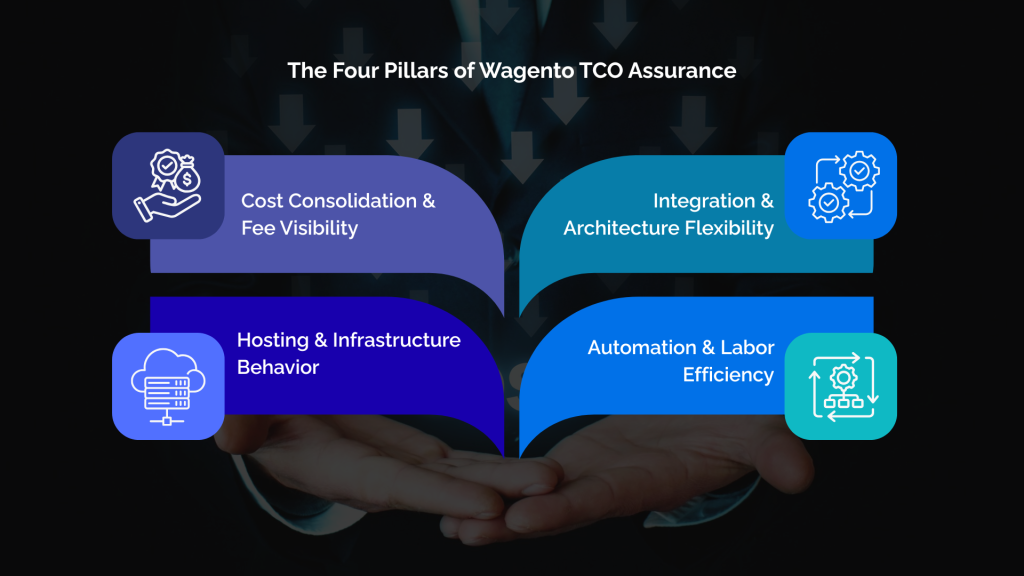
1. Cost Consolidation & Fee Visibility
This pillar evaluates how costs are distributed across:
- Platform licensing
- Extensions and apps
- Middleware and integrations
- Custom development
The goal is not to eliminate costs, but to make them visible, predictable, and comparable over time.
2. Hosting & Infrastructure Behavior
Different platforms handle traffic, scaling, and infrastructure differently.
Wagento TCO Assurance examines:
- How hosting costs change during growth or seasonality
- Whether scaling introduces forced upgrades
- How much control teams have over performance tuning
Infrastructure behavior plays a major role in long-term cost stability.
3. Integration & Architecture Flexibility
Integrations are rarely “one-time” efforts.
This pillar measures:
- Depth of system integrations
- Ongoing maintenance requirements
- Dependency on third-party connectors
- Long-term architectural sustainability
The focus is on how integration choices affect cost over years, not months.
4. Automation & Labor Efficiency
Automation reduces:
- Manual effort
- Repetitive tasks
- Operational errors
- Team dependency
Wagento TCO Assurance quantifies how automation impacts:
- Team workload
- Operational cost
- Scalability
Labor efficiency is often one of the largest long-term savings drivers.
The Wagento TCO Calculator
The Wagento TCO Calculator operationalizes this framework by analyzing:
- Current platform spend
- Tools and integrations in use
- Maintenance and operational effort
- Team hours tied to platform workflows
- Infrastructure needs
- Future growth plans
It then projects:
- 5-year ownership cost
- Cost curve over time
- Break-even points
- ROI scenarios
The calculator will be available as part of the Wagento TCO Assurance initiative, enabling transparent, scenario-based evaluation.
What Executives Actually Need From TCO Analysis
From a leadership perspective, TCO analysis should answer:
- Where do costs truly accumulate?
- Which costs scale with growth?
- Which costs are operational vs structural?
- How does platform choice impact team efficiency?
- What risks exist beyond subscription fees?
Wagento TCO Assurance is designed to answer these questions without platform bias.
Final Thoughts
Platform selection should not be driven by perception, marketing narratives, or surface-level pricing comparisons.
It should be driven by:
- Operational reality
- Financial visibility
- Long-term scalability
- Team efficiency
Different platforms serve different business models exceptionally well. The challenge is not choosing the “best” platform — it is choosing the right platform with full cost awareness.
Wagento TCO Assurance exists to provide that awareness.
If your organization wants to:
- Understand its true 5-year cost curve
- Remove guesswork from platform evaluation
- Align technology decisions with financial outcomes
👉 Request early access to the Wagento TCO Calculator
👉 Download the TCO Methodology Summary
👉 Book a TCO Assurance Consultation
Your platform decision should be guided by clarity, not bias — and by numbers, not assumptions.