



Companies across every industry face the same painful reality. Their systems do not talk to each other. Customer data gets trapped inside CRMs. Product data stays stuck inside PIMs. Inventory updates in the ERP but does not sync to the eCommerce platform. Warehouse teams are forced to work with outdated numbers. Finance teams manually reconcile payments. And marketing teams operate blind without real-time visibility.
This fragmentation creates thousands of manual tasks every week. Data inconsistencies lead to canceled orders, incorrect delivery estimates, lost revenue, and frustrated customers. Operations slow down. Teams burn out. The business loses momentum.
The solution is not a new plugin or another standalone tool. The solution is smart, connected, real-time integration across ERP, CRM, PIM, WMS, payment gateways, and all your eCommerce platforms. When your systems flow together seamlessly, the entire business operates with clarity, speed, and accuracy.
This is the power of 2026 system integration.
This is how modern organizations grow without friction.
This is how you eliminate manual work forever.
Start Your Integration Roadmap
Discover how to connect ERP, CRM, PIM, WMS, and all your sales channels into one unified flow.
The 2026 Integration Landscape: Faster, Smarter, Real Time
2026 marks a turning point. Enterprises no longer settle for delayed batch updates or siloed data. Integration is now a core strategic initiative, not a back-office IT task. The shift is driven by three forces:
1. The explosion of multi-system operations
Modern businesses rely on more software than ever.
Common stacks now include:
- ERP for financials and supply chain
- CRM for sales and customer data
- PIM for product information
- WMS for warehouse operations
- OMS for order routing
- eCommerce for online sales
- POS for in-store transactions
- Marketplaces for omnichannel reach
- Payment gateways for transactions and reconciliation
- Marketing tools for personalization and automation
Every one of these systems creates data. If they are not connected, the business becomes trapped in manual work.
2. Customer expectations for live accuracy
Buyers expect:
- Real time stock visibility
- Real time order updates
- Real time delivery timelines
- Real time pricing
- Real time customer support
This is only possible when every system synchronizes instantly.
3. AI-powered integrations entering the mainstream
AI has transformed integration from simple data movement to intelligent automation.
AI-powered integration now includes:
- Predictive data sync
- Automated error resolution
- Data cleanup before syncing
- Smart order routing
- Customer record merging
- Automated workflows across platforms
Enterprises adopt agentic integrations that act independently, correct inconsistencies, and maintain data health without human intervention.
Why Integration Matters More Than Ever for eCommerce and B2B
Disconnected systems are not just an inconvenience. They create financial and operational risks.
Below are the most critical business problems integrations solve.
Problem 1: Manual data entry destroys efficiency
Companies waste hundreds of hours every month on tasks such as:
- Entering sales orders into ERP
- Updating product specs in multiple systems
- Syncing customer profiles manually
- Copy pasting inventory updates
- Recreating shipping data
Manual tasks increase labor cost, slow down operations, and introduce errors.
Integration automates it all.
Problem 2: Data inconsistencies break customer trust
When CRM, ERP, WMS, and eCommerce do not sync:
- Inventory looks available but is actually out of stock
- Pricing and discounts show incorrectly
- Customer records do not match
- Orders get lost
- Warehouse receives outdated pick lists
- Finance receives inaccurate reconciliation data
Every inconsistency affects customer satisfaction and profitability.
Problem 3: Teams cannot make good decisions without unified data
Without real time integration:
- Sales cannot forecast
- Marketing cannot personalize
- Operations cannot plan
- Finance cannot reconcile
- Leadership cannot strategize
Integration creates one source of truth so every team has accurate information.
Problem 4: Growth becomes slow and unpredictable
A disconnected tech stack makes it impossible to scale.
Growth requires:
- Efficient processes
- Fast operations
- Consistent data
- Automated workflows
- Unified systems
Integration unlocks all of these.
Learn how modern B2B brands are preparing
10 Essential Integrations Every Business Needs
Below are the most important integrations driving growth this year.
1. ERP Integration
ERP integration is the foundation for operational stability.
It syncs:
- Inventory
- Orders
- Fulfillment
- Pricing
- Accounting
- Invoices
- SKUs
ERP integration reduces errors, eliminates duplicate work, and ensures financial accuracy.
Popular ERP systems:
Microsoft Business Central, SAP, Netsuite, Odoo, Acumatica, Epicor, Sage.
2. CRM Integration
CRM integration connects marketing and sales to operations.
CRM data fuels:
- Lead qualification
- Sales forecasting
- Customer segmentation
- Personalized marketing
- Customer retention strategies
A real time CRM integration helps teams track the entire customer lifecycle seamlessly.
3. PIM Integration
PIM integration solves product data chaos.
It ensures:
- Accurate and centralized product information
- Clean attributes and categories
- Consistent product descriptions
- Real time updates across channels
B2B and large catalog brands rely heavily on PIM integration for multichannel success.
4. WMS Integration
Warehouse management is the heartbeat of fulfillment.
WMS integration syncs:
- Inventory levels
- Pick lists
- Order statuses
- Warehouse locations
- Fulfillment timelines
This integration prevents overselling and improves delivery accuracy.
5. Payment Gateway Integration
Payment gateway integration goes far beyond transactions.
In 2026 it includes:
- Automated reconciliation with ERP
- Fraud protection using AI
- Multi-currency support
- Tokenized payments for headless commerce
- Subscription billing automation
6. Middleware Integration
Middleware creates a central hub for complex systems.
Middleware platforms provide:
- Prebuilt connectors
- Unified mapping rules
- Faster data transformation
- Consistent monitoring
- Reduced custom coding
This reduces long-term technical debt and improves scalability.
7. OMS Integration
OMS integration brings order intelligence into your operations.
It handles:
- Order routing
- Approval workflows
- Fulfillment logic
- Multi-warehouse decision making
This helps reduce order errors and improves customer satisfaction.
8. Marketing Automation Integration
Connecting CRM, eCommerce, and marketing tools unlocks powerful automation.
It enables:
- Lifecycle journeys
- Real time triggers
- Behavioral segmentation
- Abandoned cart automation
- Personalized email flows
Marketing becomes more accurate and more profitable.
9. Headless Commerce Integrations
Headless setups rely entirely on APIs.
This means integrations are the backbone of user experience.
Headless integration connects:
- Backend ERPs
- Pricing engines
- Catalog systems
- Inventory engines
- Frontend experiences
Explore how headless commerce architectures rely on fast and accurate API integrations.
10. AI Powered Integration Across All Systems
This is the biggest innovation in 2026.
AI powered integration can:
- Auto correct data inconsistencies
- Suggest field mappings
- Merge duplicate customer records
- Identify missing product attributes
- Predict incorrect inventory updates
- Trigger automated workflows
According to McKinsey’s 2025 tech outlook, the most impactful trends for modern businesses involve AI, cloud and connected infrastructure.
AI is transforming integration into an intelligent, self healing system.
See how AI and machine learning are reshaping digital commerce in 2025.
Fix Your Data Sync Problems
Get real time data synchronization across ERP, CRM, PIM, WMS, and all your channels.
Real Time Data Sync: The Backbone of the Modern Enterprise
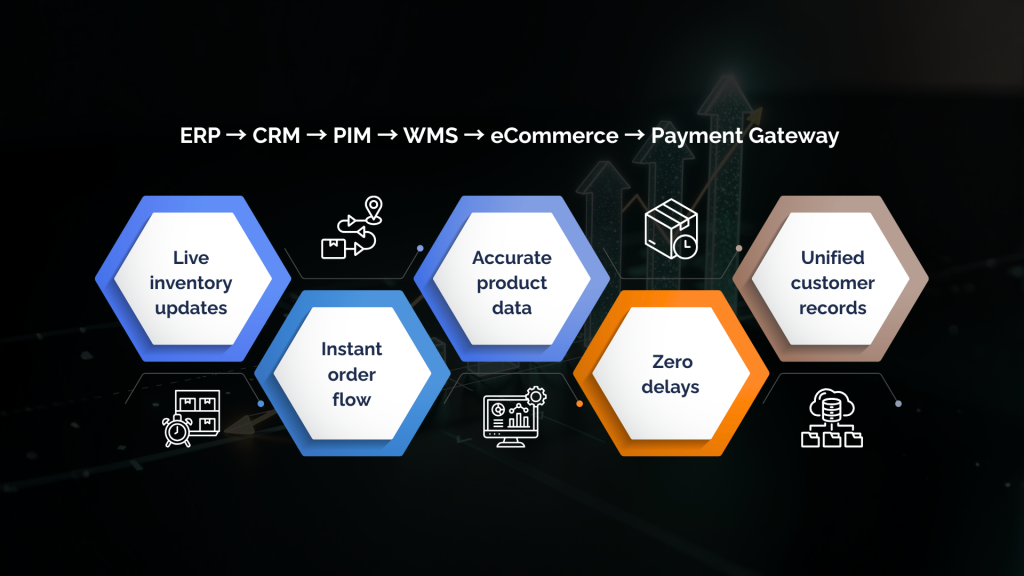
Real-time sync removes the delays and errors that slow down business operations.
Benefits of real time sync
- Accurate inventory
- Faster delivery timelines
- Single source of truth for data
- Faster order updates
- Improved customer experience
- Lower support volume
- More predictable operations
Where real time sync matters most
- eCommerce and ERP
- CRM and marketing
- PIM and storefront
- WMS and OMS
- Payment gateway and accounting
This operational clarity is what allows companies to scale efficiently.
Composable Commerce Integrations: Flexibility Without Replatforming
Composable commerce has become the preferred strategy.
Instead of one giant platform, businesses use a collection of best-in-class tools.
This requires seamless integration between microservices like:
- Catalog
- Cart
- Checkout
- Search
- Payments
- PIM
- OMS
- Analytics
Composable commerce integrations make it easy to launch features, switch vendors, and scale faster without rebuilding the entire platform.
As BigCommerce explains in 2025, composable commerce empowers brands to pick best-of-breed modules and integrate them via APIs to build flexible, scalable commerce tech stacks.
Integration Frameworks That Simplify Complexity
Integration frameworks focus on reducing development time and increasing reliability.

The most popular frameworks include:
- iPaaS (Integration Platform as a Service)
- Prebuilt connectors
- Middleware platforms
- Cloud based integration services
- Unified API layers
These frameworks help companies build integrations once and reuse them across multiple platforms.
The Financial Impact of Automated Integrations
When businesses automate workflows through integrations, they gain measurable financial improvements.
Below are the most common impacts:
Cost reductions
- Less manual labor
- Fewer order errors
- Cleaner data
- Faster reconciliation
- Lower operational delays
Revenue increases
- Faster order processing
- Higher customer satisfaction
- Consistent inventory
- Personalized marketing
- Better forecasting
Integration directly contributes to profitability.
What a Fully Connected, Automated Business Looks Like

When every system is integrated, your operations transform.
You get one source of truth
No more conflicting numbers. Every team sees the same data.
Your workflows become automated
Orders process themselves.
Inventory syncs itself.
Customer data updates itself.
You eliminate manual work
Your team focuses on strategic work instead of repetitive tasks.
You deliver better customer experiences
Accurate inventory. Fast delivery. Real time updates. Reliable communication.
You scale without chaos
Growth becomes predictable, controlled, and sustainable.
Build a Connected eCommerce Ecosystem
Connect ERP, CRM, PIM, WMS, payment gateways, and all your channels into one seamless engine.
Frequently Asked Questions (FAQs)
1. Why are integrations critical for eCommerce?
Modern eCommerce operations depend on accurate data across multiple systems. Without integration, businesses suffer from inventory mismatches, delayed updates, manual work, and order errors. Integrations ensure that ERP, CRM, PIM, WMS, and eCommerce platforms operate in sync, creating efficiency and better customer experiences.
2. What systems should be integrated first?
The most important systems to integrate first are ERP, CRM, PIM, WMS, and your primary eCommerce platform. These systems affect inventory, orders, fulfillment, customer records, and product data. Connecting them creates an immediate impact on accuracy and operational speed.
3. How does AI improve system integration?
AI improves integration by detecting errors, cleaning data, mapping fields automatically, predicting mismatches, and triggering workflows without human intervention. AI powered integrations reduce manual work and keep data consistent across platforms.
4. What is real time data sync and why does it matter?
Real time data sync updates information across systems instantly. This prevents delays, reduces errors, improves order accuracy, and creates a unified view of your business. It is essential for modern eCommerce where customers expect accurate and immediate information.
5. What is the ROI of integration projects?
Integration projects deliver significant ROI through reduced labor costs, lower error rates, improved customer satisfaction, faster operations, and more accurate forecasting. Businesses typically see operational improvements within weeks and cost savings within months.