





The eCommerce landscape is more competitive than ever. With consumers spoiled for choice, the question is no longer whether you have the best products or the lowest prices. The real battleground is customer experience (CX).
From the moment a shopper first discovers your brand to the instant they reorder or recommend you to friends, every interaction defines whether they stay loyal or switch to a competitor. Great CX means more repeat purchases, higher lifetime value, and sustainable growth.
In this article, we’ll explore why CX is the key driver of eCommerce growth in 2025, backed by insights from leading industry blogs and brands. You’ll find practical strategies, examples, and future-focused ideas you can apply right away.
The Rise of Customer Experience as the Growth Engine
Why CX Outranks Product and Price
Until recently, businesses could rely on competitive pricing or a great product catalog to win customers. That is no longer enough.
- Choice overload: Consumers have hundreds of similar options online. Experience is what makes them stay.
- Lower switching costs: With one click, a buyer can abandon you for a competitor.
- Trust and loyalty as currency: A great experience leads to word-of-mouth referrals and organic growth.
SuperOffice’s 2025 report found that 86% of buyers are willing to pay more for a better customer experience, even if the product is more expensive elsewhere.
For B2B companies, customer experience has become just as important as in B2C. As outlined in our strategies for the future of B2B eCommerce, focusing on seamless digital journeys and trust-building is critical to growth.
Discover how your store measures up.
Omnichannel Customer Experience: Consistency is Key
What Omnichannel CX Means
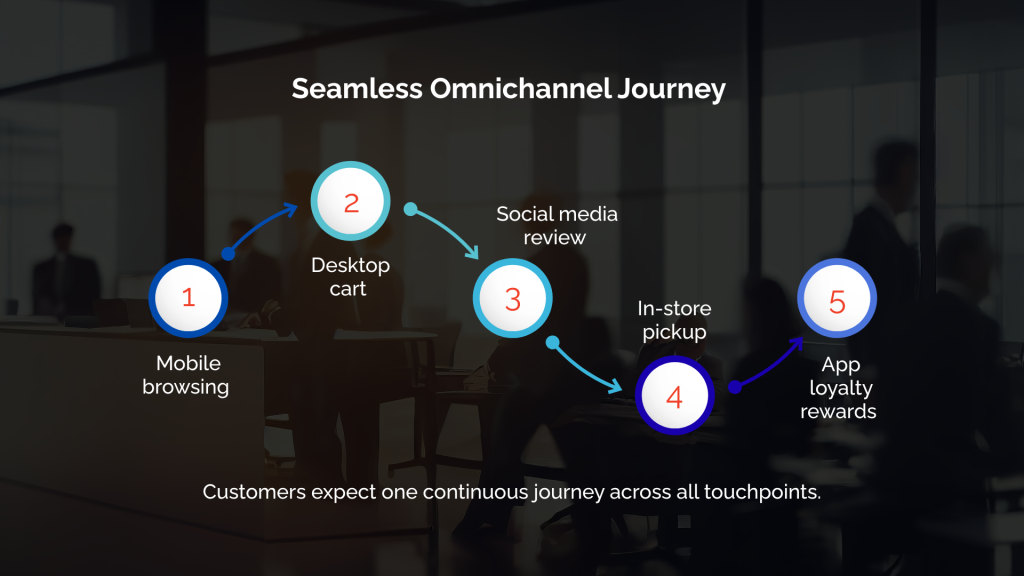
Omnichannel experience is more than just being present on multiple channels. It’s about connecting those touchpoints into one seamless journey.
- Shopify’s 2025 research shows that omnichannel-first brands grow revenue 23% faster than single-channel competitors.
- Contentful’s findings confirm that most customers switch between at least 3 devices or platforms before completing a purchase.
- According to recent research, 75 % of shoppers now use both digital and physical touch-points in the same customer journey, reinforcing the need for true channel integration. [Feedonomics]
Examples of Excellent Omnichannel CX
- Nike: Customers can start a shopping journey on the app, reserve in-store pickup, and access personalized training content.
- Sephora: Loyalty points, purchase history, and personalized recommendations are synchronized across mobile, online, and physical stores.
- Starbucks: Customers can order via app, pick up in-store, and earn rewards seamlessly across all touchpoints.
Customer Journey Optimization: Anticipating Every Step
Why Journey Mapping Matters
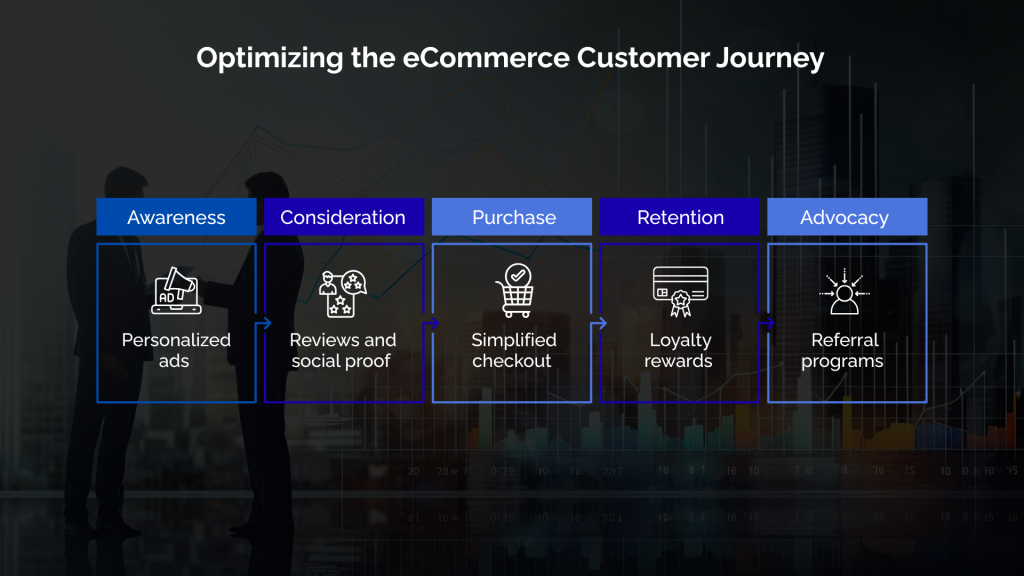
The modern eCommerce journey is non-linear. Shoppers bounce between awareness, research, comparison, and purchase, often influenced by ads, reviews, or social media.
Genesys 2025 reports that over 70% of eCommerce customers interact with 5 or more touchpoints before converting.
Practical Steps for Journey Optimization
- Audit your journey: Map every touchpoint from awareness to advocacy.
- Fix friction points: Long load times, complex checkouts, or hidden shipping costs are deal-breakers.
- Trigger contextual nudges: Cart abandonment emails, product videos, or reviews at decision points.
- Enable cross-device continuity: Save carts and preferences across desktop, mobile, and app.
- Post-purchase focus: Automate personalized thank-you messages, re-engagement emails, and loyalty rewards.
Personalization in eCommerce: Retention’s Best Friend
Beyond “Recommended for You”
Personalization has evolved from static product suggestions to AI-powered, contextual experiences.
Emarsys 2025 highlights three new layers of personalization:
- Real-time personalization: Offers that change based on behavior in-session.
- Predictive personalization: AI predicting what a customer will need next.
- Privacy-first personalization: Transparent use of data to build trust.
The ROI of Personalization
- Emarsys data: Personalized experiences increase repeat purchases by 20%.
- Icecube Digital’s research: Brands using personalization see up to 25% higher LTV.
Personalization also reduces acquisition costs, as loyal customers spend more and refer others.
Hyper-personalisation and real-time sentiment analysis are now among the top CX trends for 2025, with firms like Emplifi highlighting that these tactics are driving meaningful loyalty gains. [Emplifi]
Learn how personalization can cut churn
The Role of CX Metrics in Driving Growth
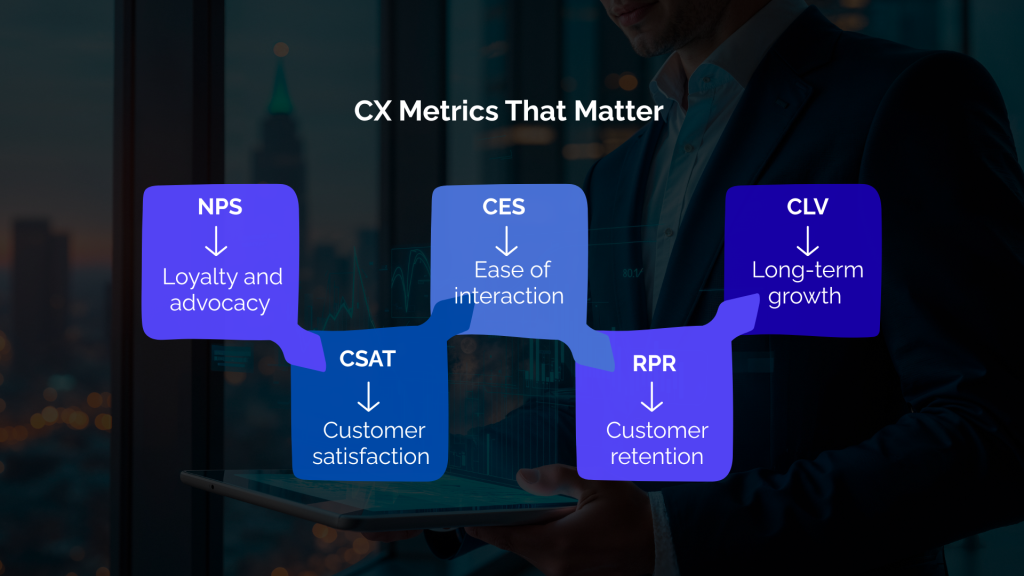
Without measurement, CX efforts can’t scale.
Key CX Metrics to Track in 2025
- Net Promoter Score (NPS): Captures loyalty and referrals.
- Customer Satisfaction (CSAT): Feedback on specific interactions.
- Customer Effort Score (CES): Measures ease of use across processes.
- Repeat Purchase Rate (RPR): Direct measure of loyalty.
- Average Order Value (AOV): Impact of upselling and CX-driven recommendations.
- Customer Lifetime Value (CLV): The ultimate growth measure.
SuperOffice stresses that tracking CX metrics correlates directly with revenue growth. For example, a 5% increase in retention can increase profits by 25% to 95%.
UX and CX Convergence: One Without the Other Fails
Why UX Alone is Not Enough
User experience (UX) focuses on usability and design. Customer experience (CX) includes emotions, support, and trust. In 2025, the convergence of both is what fuels growth.
Examples:
- A fast-loading, mobile-friendly store (UX) combined with personalized offers (CX).
- A one-page checkout (UX) plus responsive live chat (CX).
Emerging Trend: AI in UX and CX
AI is bridging the gap by:
- Predicting customer intent.
- Offering adaptive interfaces (UX shifts based on user behavior).
- Automating support without losing personalization.
AI is already reshaping eCommerce by predicting customer intent, enabling personalization at scale, and automating service. Our article on AI in eCommerce explores seven ways businesses can leverage these tools to improve experience.
Case Studies: Brands Winning with CX
Amazon
From 1-click checkout to predictive shipping, Amazon sets the gold standard for removing friction and anticipating needs.
Warby Parker
Their virtual try-on feature reduces returns while building confidence, showing how UX + CX convergence drives conversion.
Zappos
Famous for “customer-first” policies, their 365-day return policy builds trust and loyalty.
Glossier
A brand built on community-led personalization, blending UX and CX to create loyalty beyond transactions.
Building a Winning CX Strategy for eCommerce Growth
Key Pillars of a 2025 CX Strategy
- Omnichannel integration: Every channel works as one.
- AI-powered personalization: Predict needs before customers articulate them.
- Proactive support: Use chatbots for basics and humans for empathy.
- Data-driven decisions: Invest in CX metrics, not just sales numbers.
- Continuous improvement: Treat CX as an evolving process, not a one-time project.
Checklist for eCommerce Growth through CX
- Do you have a connected omnichannel journey?
- Are friction points identified and resolved quickly?
- Are your personalization efforts consent-driven and AI-enabled?
- Are you tracking metrics that reflect experience, not just revenue?
Proactive support is now a growth driver. Chatbots, for example, provide instant answers, guide shoppers through checkout, and free up human agents for complex cases. Our guide to chatbots in eCommerce details how they boost CX and retention.
The Future of CX in eCommerce: What’s Next?
Looking ahead to 2026 and beyond, several trends will redefine how CX fuels growth:
- Agentic AI in eCommerce: Shopping agents will anticipate customer intent and execute purchases autonomously.
- Hyper-personalization: Tailored experiences will go beyond segments into “segments of one.”
- Immersive commerce: AR, VR, and metaverse-like experiences will become mainstream in customer journeys.
- Sustainability-driven CX: Customers increasingly value transparency and ethical business practices.
- Voice commerce: Smart assistants will reduce the number of clicks between intent and purchase.
FAQs
Great CX reduces churn, boosts repeat purchases, and drives referrals. In 2025, growth depends on whether customers feel understood and valued.
Key metrics include NPS, CSAT, CES, Repeat Purchase Rate, AOV, and CLV. These metrics connect directly to long-term profitability.
UX is about usability and design. CX includes the emotional and experiential side. When combined, they create a powerful growth engine.
Personalization makes experiences relevant, reduces decision fatigue, and strengthens trust. This leads to longer relationships and higher lifetime value.
Nike, Sephora, and Amazon all show how integrating omnichannel, personalization, and frictionless design creates growth.
Conclusion
In 2025, customer experience is no longer a competitive advantage. It is the foundation of eCommerce success.
Brands that master omnichannel consistency, personalize journeys, measure CX impact, and merge UX with CX will dominate the market. Customers have endless choices, but they reward brands that deliver experiences that are easy, personal, and trustworthy.
Ready to transform your customer experience?
Contact us today and unlock new growth opportunities.