




Why flexibility, speed, and complexity are reshaping the future of B2B eCommerce
Introduction
Headless commerce is no longer just a buzzword in 2026. For B2B companies dealing with complex product catalogs, contract pricing, dealer portals, and multi-channel experiences, headless architecture has become a serious consideration.
But is headless really the right choice for every B2B business? Or are there situations where the traditional, monolithic eCommerce approach still delivers better ROI?
This article explores the pros and cons of headless for B2B commerce, helping you decide when to switch, what benefits to expect, and what challenges to prepare for.
What is Headless Commerce for B2B?
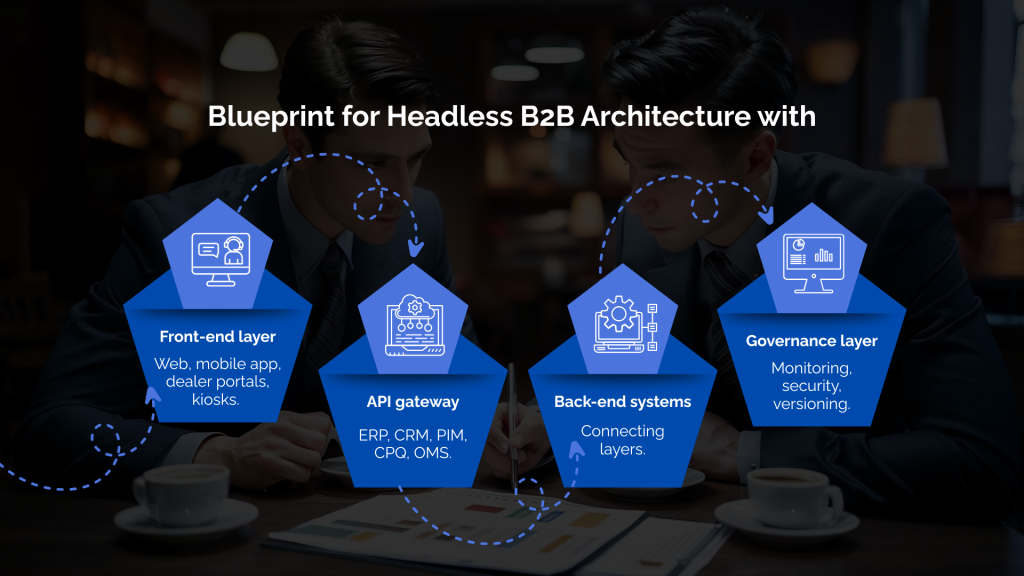
Headless commerce separates the front-end presentation layer (website, mobile app, kiosk, or even IoT device) from the back-end business logic (inventory, pricing, checkout, ERP integration).
Instead of one platform handling everything in a monolithic way, headless uses APIs to connect services.
- Front-end: built in modern frameworks like React, Vue, or Next.js.
- Back-end: ERP, PIM, CRM, CPQ, and order management systems handle the heavy lifting.
- APIs: bridge the gap between front-end and back-end.
For B2B commerce, this setup means buyers, procurement managers, and sales reps can each get a tailored experience across multiple devices, while backend systems continue running the complex rules that drive your business.
For a clear, up-to-date breakdown of headless commerce architecture, check out BigCommerce’s “2025 Guide for Success” which explains how decoupled front-ends and API-driven back-ends are supporting both B2B and B2C strategies.
If you want to see how headless commerce works in practice, our article on Decoding Headless Commerce on BigCommerce explores real-world use cases and technical setups.
Need Expert Guidance on Going Headless?
Thinking about headless commerce for your B2B site but not sure where to start? Our eCommerce specialists can help you evaluate your setup, identify gaps, and plan a future-ready migration strategy.
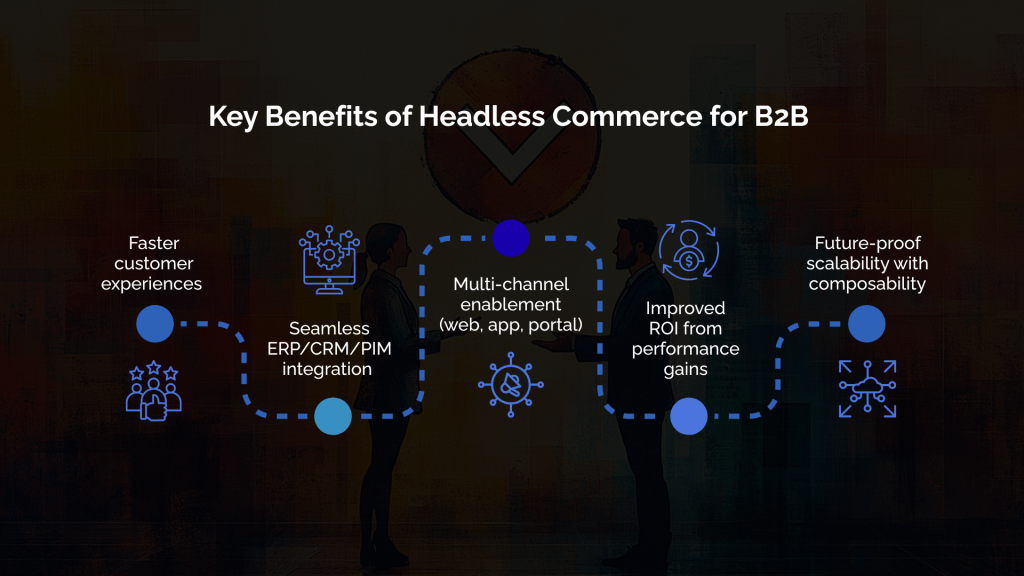
Benefits of Headless B2B Commerce
1. Flexibility in Customer Experience
Headless enables businesses to design unique buyer experiences across web, mobile, dealer portals, and custom applications.
- Personalized catalogs for different buyer roles.
- Faster A/B testing on front-ends without disrupting backend systems.
- Improved Core Web Vitals scores that impact SEO and conversions.
To better understand how headless fits into the bigger picture of B2B growth, explore our guide on the Future of B2B eCommerce in 2025, where we break down the top strategies driving digital adoption.
2. Seamless API-Driven Integrations
B2B sales are not as simple as one-click consumer checkouts. They require:
- Complex pricing logic tied to contracts and customer groups.
- ERP/CPQ/PIM integration for product data, pricing, and approvals.
- CRM connectivity for sales team visibility.
Headless commerce shines here because APIs let you plug and play these systems without breaking the store.
3. Multi-Channel Enablement
Buyers no longer operate on a single channel. They might browse on desktop, order through a mobile app, or request quotes via a dealer portal.
Headless allows you to reuse business logic across all touchpoints. The result is faster launches of new channels and consistent customer experiences.
4. Performance and ROI Uplift
Studies in 2025 continue to show that page load times and smooth UX directly drive B2B conversions. With headless, sites can be highly optimized for speed.
- Improved Lighthouse and Core Web Vitals scores.
- Reduced bounce rates.
- Faster time-to-purchase for repeat B2B buyers.
5. Future-Proofing Through Composability
Instead of replatforming every time you need a new feature, headless lets you swap services independently.
- Replace your search engine without touching checkout.
- Upgrade your CMS without impacting product data flows.
- Extend into new geographies or marketplaces with minimal disruption.
This flexibility makes headless attractive for scaling B2B organizations.
Challenges of Headless B2B Commerce
1. Higher Implementation Complexity
Unlike monolithic platforms where you “buy it all in one,” headless requires building and connecting multiple services.
- Developers must be skilled in APIs and modern frameworks.
- Product managers must oversee multi-service roadmaps.
- Release cycles become more complex with multiple moving parts.
2. Total Cost of Ownership
While headless promises agility, it often comes with higher costs:
- Multiple vendors (front-end hosting, backend services, observability tools).
- Larger development teams.
- Ongoing governance overhead.
For smaller B2B firms, these costs may outweigh the benefits.
3. Governance and API Management
With headless, every service has its own updates, versioning, and SLAs.
Without strong governance:
- Integrations may break during updates.
- Front-end and backend teams may fall out of sync.
- Customer experience risks inconsistency.
4. ROI May Take Time
While long-term ROI can be significant, many companies underestimate the ramp-up time.
- Training teams.
- Rewriting integrations.
- Establishing DevOps pipelines.
Expect a longer payback period compared to out-of-the-box monolithic solutions.
Headless vs Monolithic B2B Commerce

When Headless Wins
- You need multi-channel buyer experiences.
- Your workflows require deep ERP/PIM/CRM integration.
- Marketing demands faster experimentation on front-ends.
- Your IT team is ready for API-first development.
When Monolithic Wins
- Your catalog and workflows are simple.
- You have a small development team.
- You prioritize quick time-to-market over extreme flexibility.
- You want predictable, lower-cost operations.
For a deep dive into how headless stacks compare with monolithic platforms specifically in B2B commerce, see Codup’s June 2025 article on evaluating which model fits your growth, tech readiness and business objectives.
Headless B2B Architecture Best Practices
Model Your Domain First
Don’t start with tools. Start by mapping your pricing rules, workflows, and buyer personas. This will guide API boundaries.
Choose Opinionated Starters
Frameworks like BigCommerce Catalyst or pre-built headless kits can reduce time-to-value and improve performance scores.
Treat Integrations Like Products
Document them, version them, and monitor them. Create an API catalog early.
Instrument ROI Metrics
Measure:
- Core Web Vitals.
- Conversion rates.
- Average order values.
- Share of self-service orders vs. assisted sales.
Change Management Matters
Empower marketers to ship changes independently while keeping release trains and API versioning under strict control.
Transform Your Store with Scalable Headless Architecture
Deliver lightning-fast buyer experiences and integrate your systems seamlessly with Wagento’s end-to-end eCommerce development services.
When to Switch to Headless in B2B
Switch if:
- You need multi-role portals (buyers, procurement, dealers).
- Your catalog requires complex contract pricing.
- You plan to add new digital channels beyond web.
- You have a skilled dev/product team to manage complexity.
Stay monolithic if:
- Your workflows are straightforward.
- Your IT budget is limited.
- You value speed of setup and simplicity.
Headless Commerce ROI in B2B
ROI in B2B isn’t just about site speed. It’s about sales enablement and operational efficiency:
- Faster procurement cycles reduce sales overhead.
- Self-service ordering reduces support costs.
- Better data orchestration improves accuracy and compliance.
Companies measuring ROI should baseline KPIs before going headless and track improvements quarterly.
According to an independent IDC study released in October 2025, companies using modern B2B commerce platforms achieved an average 391% ROI and a pay-back period of just 7 months.
For insights into how emerging technologies like AI shopping agents will pair with headless architectures to transform buyer journeys, see our article on AI Shopping Agents in eCommerce.
FAQs
What is the main benefit of headless commerce for B2B?
The biggest benefit is flexibility. B2B businesses can deliver tailored experiences for different buyer roles while integrating deeply with ERP, PIM, and CRM systems.
Is headless commerce more expensive than traditional platforms?
Yes, typically. While the long-term ROI can be strong, initial costs are higher due to multiple vendors, integrations, and governance needs.
How do APIs improve B2B headless commerce?
APIs enable seamless data flow between your commerce front-end and backend systems like ERP and CRM. This reduces errors and improves efficiency.
When should a company avoid headless?
Avoid headless if your catalog is simple, your team lacks advanced development skills, or if speed-to-market matters more than flexibility.
What are the best practices for headless architecture in B2B?
Map your workflows first, use starter frameworks, monitor integrations, and track ROI metrics consistently.
Conclusion
Headless commerce for B2B in 2025 is powerful but not universal. For complex enterprises, it unlocks agility, performance, and personalization that monolithic platforms struggle with. For simpler businesses, it may add unnecessary cost and complexity.
The decision comes down to one question: Does your current and future B2B model require flexibility across channels, systems, and experiences that only headless can deliver?
If yes, the investment will pay off. If no, a monolithic solution may be your safer, more cost-effective path.
Start Building Your Headless Commerce Strategy Today
Take the first step toward a more flexible, API-driven B2B platform. Connect with Wagento’s team to design, develop, and scale your headless commerce solution.